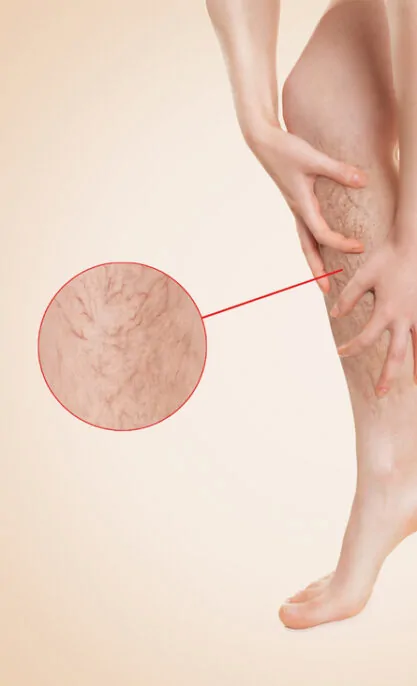
Varicose veins are enlarged, dilated, and twisted superficial veins, typically found in the legs just under the skin. They appear as thick blue, serpiginous (snake-like) lines of veins that can be pressed upon and decrease in size after elevating the legs. Varicose veins are usually asymptomatic, but some individuals may experience fatigue or pain in the calf region. Complications can include bleeding, superficial thrombophlebitis, or the development of ulcers. The physical, social, and psychological effects of varicose veins can significantly impact one’s quality of life.
Varicose veins occur when the tiny, one-way valves inside the veins weaken or are damaged. In healthy veins, these valves ensure that blood flows in one direction only, towards the heart. When these valves weaken and fail to close properly, some blood flows backward against gravity and accumulates in the vein. This added blood exerts pressure on the vein walls, causing them to weaken and bulge over time, leading to the formation of spider veins and, eventually, varicose veins.
Treatment for varicose veins typically involves a thorough physical examination and specific investigations (Doppler) before planning the appropriate treatment. Preventive measures can help stop the development of new varicose and spider veins, but they can’t eliminate existing ones. There are both medical and surgical methods available to treat varicose veins effectively and safely.
Varicose veins are a common condition, affecting approximately 30% of the population, and becoming more prevalent with age and in women.
Lifestyle Changes: Lifestyle changes can control the progression of the disease, including:
Wearing compression stockings.
Regular exercise.
Elevating the legs.
Weight loss.
Mild and Initial Cases: Conservative treatment is recommended. This includes the above lifestyle changes, along with:
Compression garments.
Anti-inflammatory medications.
Topical creams for skin issues.
Moderate to Severe Cases: Conservative approaches may not be sufficient, and medical or surgical intervention may be necessary. Medical procedures include techniques that block the veins, directing blood away from the affected area and toward deep and nearby veins.
There are two primary procedures for varicose vein treatment:
Injection Sclerotherapy (for small veins): This outpatient office procedure involves staying at the center for about 2 to 3 hours. The affected veins are injected with a sclerosing solution, which irritates the inside of the vein. Over time, the vein collapses and fades away. Patients are required to wear compression stockings for 3 weeks to prevent possible side effects. Most individuals can return to work the day after the procedure.
Vein Ligation and Stripping: This surgical procedure empties the collected blood in veins and ligates the faulty valves with surgical knots. The abnormal veins are then removed. This is considered a definitive treatment with a low risk of recurrence compared to other methods.
Patients are instructed to wear compression garments to promote proper healing.
Discharge usually occurs the day after surgery.
Sutures are removed after 14 days.
Most individuals can resume normal activities within a week or two, following specific instructions from their surgeon.
Patients should follow post-surgical precautions, including wearing compression garments for three to six months and avoiding prolonged sitting or standing.
Always discuss previous surgeries and medical conditions with your healthcare provider.
Wear support stockings as prescribed to reduce swelling and maintain proper shape.
Consult your doctor immediately if complications arise.
Maintain a healthy lifestyle for the best and most long-lasting results.
Ready for Your Transformation? Contact Dr. Amit Agarwal Today for Expert Varicose Veins Surgery and Reveal Your Best Self!
Are you ready for a consultation?
Your treatment will be performed by board certified plastic surgeon. Schedule your appointment now!
Are you ready for a consultation?
Your treatment will be performed by board certified plastic surgeon. Schedule your appointment now!
A True Devotion to Healing
Where Compassionate Care Meets Advanced Medicine, Guiding You on the Path to Recovery and Well-being.
24/7 Patient Support
We understand that questions and concerns don’t have office hours. That’s why we offer round-the-clock support, ensuring you have access to the care and information you need, whenever you need it.
Premium Quality Materials
We commit to only using the highest-grade materials and the latest technology in your procedures. This commitment is our promise to you for superior outcomes and your utmost satisfaction.
Safety and Hygiene Promise
Your well-being is our top priority. Across our practice, we adhere to stringent safety and hygiene protocols, reassuring you of your safety and comfort at every step of your journey with us.
If you have blue enlarged, dilated, and twisted superficial veins typically in the legs, just under the skin, and have dull aching pain or recurrent ulcers in the leg, then you are a suitable candidate for the surgery.
Quitting smoking is a perfect solution even without surgery as it involves many health risks, but it’s totally up to you whether you want to quit or not. But you should surely stop smoking before the procedure and 2 weeks after the injection.
Privacy is of utmost importance to us. Rest assured, all your personal and medical information is handled with strict confidentiality.
TRUST
Our Surgeon is highly qualified and internationally certified with a team of skilled staff to perform any surgical or non-surgical treatment on your body.
SAFETY
Safety is our priority. We maintain stringent protocols to ensure a secure environment for all patients and staff members.
Breast augmentation and breast reduction are two very different procedures. Augmentation (breast enlargement) increases breast volume and alters shape, usually for cosmetic or reconstructive goals. Reduction removes breast tissue and skin to make breasts smaller and relieve symptoms. In general, augmentation is chosen by patients who want fuller, more symmetrical breasts (or as reconstruction after…
Rhinoplasty, commonly known as a “nose job,” is a surgical procedure to reshape the nose. It can be performed for cosmetic enhancement of appearance or for functional improvement of breathing (and often both). If you’re medically informed and considering rhinoplasty, it’s important to understand the types of rhinoplasty, what the surgery involves, and how the…
When diet and exercise don’t address certain stubborn fat deposits, liposuction can be a safe and effective solution—when chosen for the right reasons and in the right patient. As a commonly performed body-contouring procedure, liposuction reshapes specific areas of the body rather than serving as a weight-loss method. At Kayakriti Plastic Surgery & Dental Center…