Abdominoplasty, commonly known as a Tummy Tuck, is a surgical procedure that focuses on body contouring rather than weight loss. It involves the removal of excess skin and, to some extent, fat from the abdominal area while also repairing separated or weakened muscles. The goal of this procedure is to create a smoother, flatter, and firmer abdomen, enhancing your overall appearance.
Abdominoplasty is particularly beneficial for individuals who:
Have lost a significant amount of weight and have loose, sagging skin.
Have thin frames but still experience saggy skin in the lower abdominal region.
Struggle to achieve a flat abdomen through exercise and diet alone.
Experience sagging skin due to factors such as significant weight fluctuations, pregnancy, previous surgeries like liposuction, or the natural aging process.
It’s important to note that Abdominoplasty cannot address issues related to excessive weight; it’s primarily focused on the removal of loose or saggy skin.
In many cases, Abdominoplasty is combined with liposuction, especially when localized fat deposits are present in the upper abdomen and flank regions. This combination allows for comprehensive body contouring.
Measure your BMI and assess fat deposits around your abdomen.
Evaluate the condition of your sagging skin, abdominal muscles, and any hernias.
Examine how much fat is located outside the muscles (which can be targeted by liposuction) and how much is intra-abdominal (inside with internal organs, which cannot be targeted by liposuction).
Assess your overall health and risk factors.
Discuss alternative options if necessary.
Take photographs.
Explain the procedure and expected outcomes.
Address any risks or complications.
Emphasize the importance of maintaining a healthy lifestyle post-surgery.
Anesthesia: General anesthesia is typically preferred for this procedure.
Tumescent Anesthesia: Tumescent anesthesia solution is infused into the fat tissues under the skin in the planned surgical area to reduce bleeding, pain, and tissue trauma.
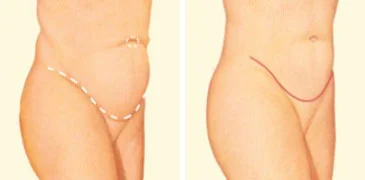
Incision and Dissection: An incision is made in the lowermost part of the abdomen along the pre-marked line. For individuals with significant excess skin, an incision may also be made around the belly button to reposition it later during the surgery. The skin flap of the lower abdomen is dissected toward the navel or belly button. The length and shape of the incision depend on the amount of skin to be removed.
Muscle Tightening and Skin Trimming: Abdominal muscles are tightened, and excess skin is stretched and trimmed.
Closure: A new opening for the belly button is created if necessary, and it is sutured into position. The incision is then closed with absorbable sutures, and skin adhesives are applied over a drain.
Risks and complications of Abdominoplasty vary among individuals and depend on their physical condition. Factors that may influence complications include poor circulation, a history of blood clots, diabetes, heart, lung, or liver infections. Some possible complications and risks include:
Rare complications related to general anesthesia.
Seroma formation (fluid accumulation), which usually resolves within a week.
Infection (rare), which may require prolonged antibiotic therapy.
Bleeding and hematoma formation may necessitate drainage.
Poor wound healing, typically seen in smokers, individuals with a high BMI, diabetes, hypothyroidism, or multiple diseases.
Numbness or altered skin sensation, which can last for 3-6 months.
Scar formation in the lower abdomen area, usually hidden under clothing may become hypertrophied in some individuals.
Skin loss or sutural dehiscence, which may require resuturing (very rare).
Persistent pain subsides with time and medication.
Prolonged swelling and skin discoloration, diminish over time.
Rare events like deep vein thrombosis, and pulmonary or cardiac complications, especially in individuals with pre-existing diseases.
The possibility of revision surgery may arise if the results do not meet your desired expectations.
The full benefits of Abdominoplasty become more apparent as swelling subsides. To maintain your results, it’s crucial to maintain a healthy lifestyle. Failure to do so might lead to new fat deposits in other areas, potentially requiring additional surgery.
Do discuss any previous surgeries or medical conditions openly with your surgeon.
Do wear a compression garment as instructed to reduce swelling and achieve the desired shape.
Do consult your doctor immediately if you experience any complications.
Do maintain a healthy lifestyle for the best and most prolonged results.
Don’t undergo surgery if you have a major chronic illness without discussing it with your doctor.
Ready for Your Transformation? Contact Dr. Amit Agarwal Today for Expert Body Plastic Surgery and Reveal Your Best Self!
Are you ready for a consultation?
Your treatment will be performed by board certified plastic surgeon. Schedule your appointment now!
Are you ready for a consultation?
Your treatment will be performed by board certified plastic surgeon. Schedule your appointment now!
A True Devotion to Healing
Where Compassionate Care Meets Advanced Medicine, Guiding You on the Path to Recovery and Well-being.
24/7 Patient Support
We understand that questions and concerns don’t have office hours. That’s why we offer round-the-clock support, ensuring you have access to the care and information you need, whenever you need it.
Premium Quality Materials
We commit to only using the highest-grade materials and the latest technology in your procedures. This commitment is our promise to you for superior outcomes and your utmost satisfaction.
Safety and Hygiene Promise
Your well-being is our top priority. Across our practice, we adhere to stringent safety and hygiene protocols, reassuring you of your safety and comfort at every step of your journey with us.
You can usually resume work within a week, but you must wear a pressure garment for 4-6 months and follow your surgeon’s instructions for the best results.
Privacy is of utmost importance to us. Rest assured, all your personal and medical information is handled with strict confidentiality.
TRUST
Our Surgeon is highly qualified and internationally certified with a team of skilled staff to perform any surgical or non-surgical treatment on your body.
SAFETY
Safety is our priority. We maintain stringent protocols to ensure a secure environment for all patients and staff members.
Breast augmentation and breast reduction are two very different procedures. Augmentation (breast enlargement) increases breast volume and alters shape, usually for cosmetic or reconstructive goals. Reduction removes breast tissue and skin to make breasts smaller and relieve symptoms. In general, augmentation is chosen by patients who want fuller, more symmetrical breasts (or as reconstruction after…
Rhinoplasty, commonly known as a “nose job,” is a surgical procedure to reshape the nose. It can be performed for cosmetic enhancement of appearance or for functional improvement of breathing (and often both). If you’re medically informed and considering rhinoplasty, it’s important to understand the types of rhinoplasty, what the surgery involves, and how the…
When diet and exercise don’t address certain stubborn fat deposits, liposuction can be a safe and effective solution—when chosen for the right reasons and in the right patient. As a commonly performed body-contouring procedure, liposuction reshapes specific areas of the body rather than serving as a weight-loss method. At Kayakriti Plastic Surgery & Dental Center…