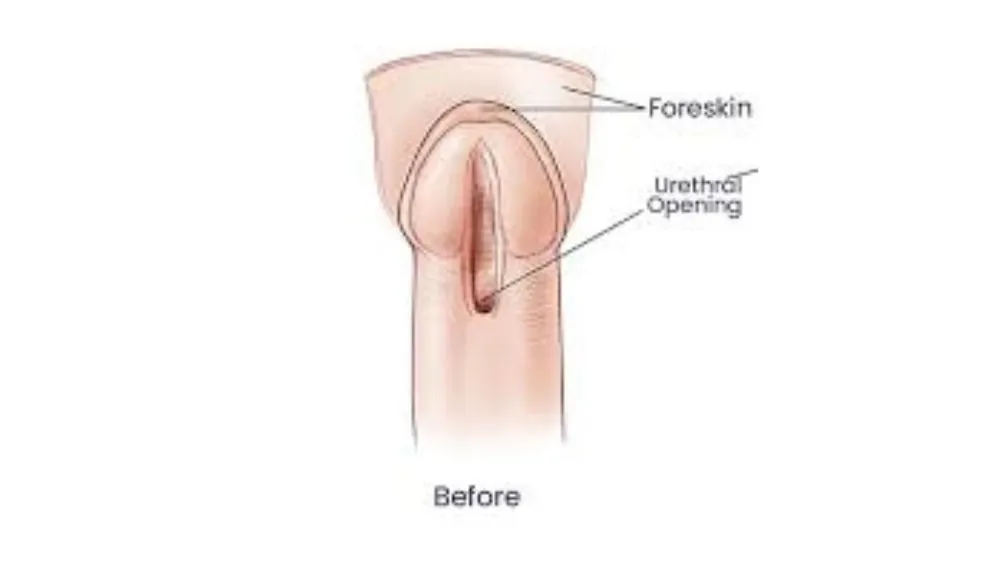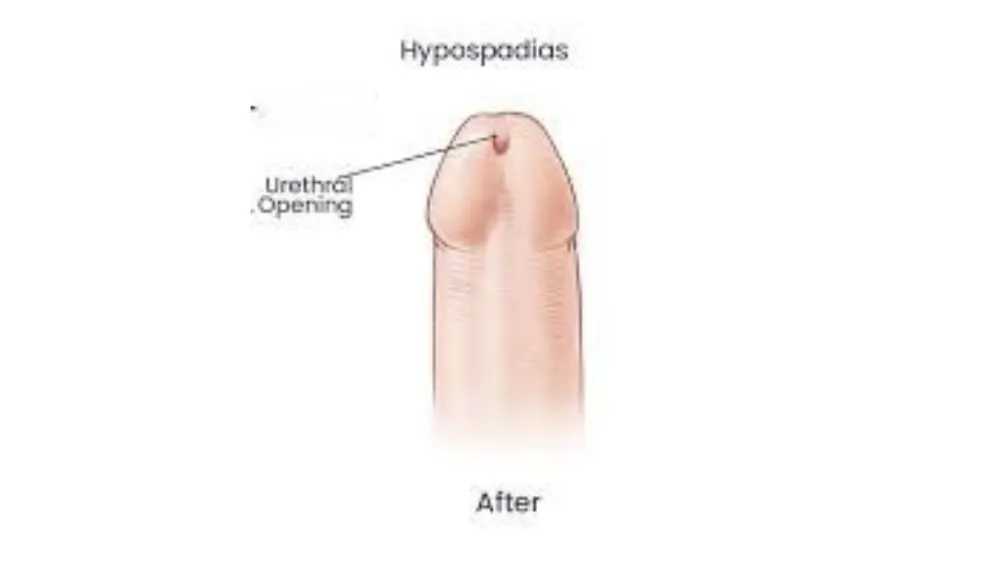
Hypospadias is a congenital anomaly of the penis observed in male infants and children. In this condition, the urinary tube (urethra) does not open at its typical location at the tip of the penis but instead opens on the underside of the penis.
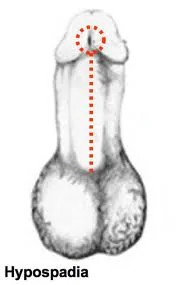
During the development of the male fetus inside the mother, certain hormones stimulate the formation of the urinary tube and the foreskin of the penis. Hypospadias results when a malfunction occurs in the action of these hormones which leads to the failure of the development of the urinary tube anywhere all along the length of the penis up to the tip of the penis.
Hypospadias can be associated with many other congenital conditions.
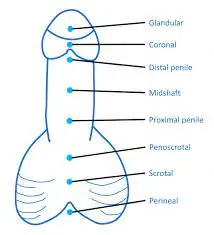
Roughly 90% of the cases are the less serious, in which the urethral opening (the meatus) is near the tip or head of the penis (glandular/ distal penile).
The remainder 10% of the children have an opening on the undersurface of the penis all the way back on the shaft of the penis, near or within the scrotum. (mid-penile/proximal penile/scrotal hypospadias respectively).
The opening of the urinary system is on the undersurface of the penis. The deformity of the urinary opening causes the spraying of urine rather than a normal stream.
In most cases, the foreskinof the penis is less developed and does not wrap completely around the penis, leaving the underside of the head of the penis uncovered.
Also, a downward bending of the penis may occur when erect which can be seen during the morning time in children.
They also have underdeveloped penile length and girth.
Living with hypospadias can be emotionally challenging for the child and the family. A child with hypospadias has to sit and micturate.
The child is often ridiculed by his friends as he cannot stand and pee.
If it is not corrected, the downward curvature of the penis (chordee) makes sexual penetration difficult in adults. This can lead to marital problems in life.
It is considered taboo to talk about any condition of penis. Such children have low self-esteem and confidence in their teenage years.
Secrecy about the condition can complicate emotional pain.
Hypospadias is not a serious medical condition and can be corrected with surgery. For the above reasons, parents of children with hypospadias seek surgery.
Surgery can–
extend the urinary tube to the end of the penis,
straighten the bending or curve of the penis, and/or
improve the esthetics of the penile foreskin.
If the penis is small, testosterone or human chorionic gonadotropin (hCG) injections may be given with the consent of the parents to enlarge it before the surgery. These injectables also increase the chance of a successful repair of the urinary tube.
The result of surgery is probably not influenced by the age at which repair is done in children. The procedure is preferred and is usually done in early childhood to eliminate the memory of some manipulation to the genitalia.
The skin of the prepuce is often used for grafting and religious circumcision should be avoided before the repair.
During the surgery, the downward curvature of the penis is corrected and a new urinary tube is created up to the tip of the penis.
Hypospadias repair is done under general anesthesia in children, most often supplemented by a nerve block to the penis or a caudal block to reduce the general anesthesia needed, and to minimize discomfort after surgery. It can be done under regional anesthesia also in adults.
Surgical repair of hypospadias may require multiple procedures.
Any complications like urinary fistula may require additional intervention for repair after 6 months
Most distal and mid-penile hypospadias (opening near the head of the penis) are corrected with a single-stage surgery. Single-stage procedures are:
a) Tubularized Incised Plate- most common operation, known as “TIP” repair or Snodgrass Repair. This procedure can be used for all distal hypospadias repairs, with success in 85%.
b) Meatal Advancement and Glanuloplasty (MAGPI)
c) MATHIEW flip flap
d) ASOPA technique.
Proximal penile/scrotal hypospadias (urinary opening near the scrotum) and downward bending of the penis are often corrected with two-stage surgery.
a) During the first surgery, the downward curvature is straightened and extra penile skin is brought to the undersurface of the penis to be used for urinary tube creation in the future. The techniques used are Bracka’s technique or Byar’s technique
b) The second surgery is done after an interval of 6 months. During the second stage, the new urinary channel is completely created from the extra penile skin on its undersurface.
After the surgery, dressing is done to secure the repair. The dressing is changed every 5 to 7 days.
The child is kept admitted to the hospital for 14 days preferably till the catheter is removed.
What are complications seen after surgery for Hypospadias repair?
The results for repair of Distal hypospadias are good in over 90% of cases.
In patients with severe hypospadias, surgery can produce unsatisfactory results, such as
Scarring,
Curvature, or
Formation of urethral fistulas (opening through the skin along the course of the urethra) is the most common complication seen,
Diverticula (outpouching along the course of the urethra), or
Strictures (narrowing of the tube from within).
Most complications are discovered within six months after the surgery.
Complications are usually corrected with another surgery, most often delayed for at least six months after the last surgery to allow the tissues to heal sufficiently.
Are you ready for a consultation?
Your treatment will be performed by board certified plastic surgeon. Schedule your appointment now!
Are you ready for a consultation?
Your treatment will be performed by board certified plastic surgeon. Schedule your appointment now!
A True Devotion to Healing
Where Compassionate Care Meets Advanced Medicine, Guiding You on the Path to Recovery and Well-being.
24/7 Patient Support
We understand that questions and concerns don’t have office hours. That’s why we offer round-the-clock support, ensuring you have access to the care and information you need, whenever you need it.
Premium Quality Materials
We commit to only using the highest-grade materials and the latest technology in your procedures. This commitment is our promise to you for superior outcomes and your utmost satisfaction.
Safety and Hygiene Promise
Your well-being is our top priority. Across our practice, we adhere to stringent safety and hygiene protocols, reassuring you of your safety and comfort at every step of your journey with us.
Hypospadias is a congenital condition in males where the opening of the urethra is located on the underside of the penis rather than at the tip. It can vary in severity and affect the appearance and function of the penis.
Symptoms of Hypospadias include an abnormal urethral opening, curvature of the penis, and difficulty with urination. It can affect an individual’s self-esteem and sexual function.
Diagnosis is made through a physical examination, and further evaluations such as ultrasound or imaging studies may be used to assess the severity of Hypospadias.
Treatment may involve surgical repair to reposition the urethral opening to the tip of the penis. The timing of surgery depends on the severity of the condition and the individual’s age.
Kayakriti Clinic specializes in the surgical repair of Hypospadias and provides comprehensive care for individuals with this condition. Their expertise and patient-focused approach ensure the best possible outcome.
Privacy is of utmost importance to us. Rest assured, all your personal and medical information is handled with strict confidentiality.
TRUST
Our Surgeon is highly qualified and internationally certified with a team of skilled staff to perform any surgical or non-surgical treatment on your body.
SAFETY
Safety is our priority. We maintain stringent protocols to ensure a secure environment for all patients and staff members.
Breast augmentation and breast reduction are two very different procedures. Augmentation (breast enlargement) increases breast volume and alters shape, usually for cosmetic or reconstructive goals. Reduction removes breast tissue and skin to make breasts smaller and relieve symptoms. In general, augmentation is chosen by patients who want fuller, more symmetrical breasts (or as reconstruction after…
Rhinoplasty, commonly known as a “nose job,” is a surgical procedure to reshape the nose. It can be performed for cosmetic enhancement of appearance or for functional improvement of breathing (and often both). If you’re medically informed and considering rhinoplasty, it’s important to understand the types of rhinoplasty, what the surgery involves, and how the…
When diet and exercise don’t address certain stubborn fat deposits, liposuction can be a safe and effective solution—when chosen for the right reasons and in the right patient. As a commonly performed body-contouring procedure, liposuction reshapes specific areas of the body rather than serving as a weight-loss method. At Kayakriti Plastic Surgery & Dental Center…