Jaw dislocation means dislocation of the lower jaw at the Temporo-mandibular Joint (TMJ). Jaw dislocation occurs when the lower jaw becomes dislodged at the Temporo-mandibular Joint (TMJ). This joint is responsible for the movement of the lower jaw during activities like eating and speaking. The upper jaw, on the other hand, remains stationary.
We have two jaws-upper and lower jaw. During all the movements of the jaw, while eating and speaking, only the lower jaw moves. The upper jaw is fixed and does not move.
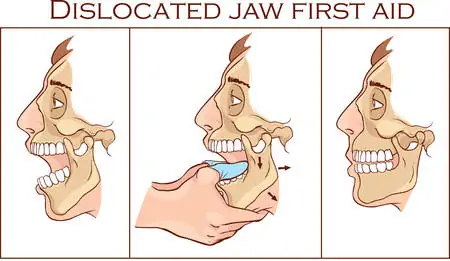
Jaw Dislocation is a condition where the head of the lower jaw (condyle) moves forward out of its functional position within the skull bone (glenoid fossa of temporal bone).
The head of the lower jaw moves and lies in front of the articular eminence (a bony area) and gets locked in this position.
It leads to stretching of the ligaments and severe spasms of the muscles resulting in severe pain in the mouth and the face with the inability to close the mouth.
The resultant spasm prevents the condyle from returning back to its natural and normal position.
Most dental treatments require the patient to open his or her mouth wide for a long period of time, which makes it likely for the dislocation to occur in susceptible patients.
Dislocation of the jaw can be acute and sudden or chronic and recurrent.
If the dislocation is sudden and acute
If the dislocation is recurrent and chronic
What are the symptoms of dislocation of the jaw?
TMJ Dislocation can be acute and sudden and can result in a locked jaw, or a jaw that sticks out forward
The mouth remains open and the front teeth do not meet, due to the action of the elevator muscles with or without deviation to one side, and depending on whether the dislocation is one-sided or both-sided.
The head of the lower jaw (mandible) is not in its usual position and the place is empty.
A dislocated jaw can interfere with eating and sleeping. It will also feel stiff, swollen, and sore.
Pain in the TMJ joint that gets worse when the jaw is moved.
TM Joint Dislocation may be reducible if the head of the lower jaw (condyle) returns spontaneously or irreducible when one or both the condyles of the lower jaw remain dislocated.
Jaw dislocation is more of a clinical diagnosis. Once you visit us, we will examine you completely but will require the following investigations for confirmation of diagnosis-
X-rays to See the status of your jaw.
CT scan to provide detailed images of the bones involved in the joint.
MRI for detailed analysis of the joint space, joint disk, or surrounding soft tissue. This is usually not done in TMJ dislocations.
A. Acute and sudden Jaw dislocation which ‘locks’ is an emergency and is reduced with a conservative approach. The Joint will be manipulated back into its correct position either manually or in a few cases by surgery.
A local anesthetic will be given so as to not feel any pain, and medicines to relax muscles so that the jaw can be moved back into place properly.
Once the jaw is back in place, it will need to be kept stable with bandages that prevent it from opening the mouth too wide.
Care should be exerted for a minimum of 6 weeks to not open the mouth wide after the reduction of the jaw.
The jaw should be supported with a hand every time one sneezes or yawns during this time.
B. Recurrent Jaw dislocation can be prevented with
Injection of autologous blood into the TM joint.
Wearing occlusal splints.
C. Treatment of Chronic Recurrent Jaw Dislocation is with Open Joint Surgery-
Open joint surgery is done under general anesthesia and a longer incision is placed within the curvature of your ear which is very well hidden. One of the following procedures can be done for the treatment-
Removal of the condyle (head of lower jaw).
Removal of the articular eminence (bony prominence).
Open joint surgery has a longer healing time and a chance of injury to the frontal branch of the facial nerve (temporary paresis of the muscle of the forehead) but still is the surgery of choice in patients with recurrent painful clicks and joint dislocations.
Are you ready for a consultation?
Your treatment will be performed by board certified plastic surgeon. Schedule your appointment now!
Are you ready for a consultation?
Your treatment will be performed by board certified plastic surgeon. Schedule your appointment now!
A True Devotion to Healing
Where Compassionate Care Meets Advanced Medicine, Guiding You on the Path to Recovery and Well-being.
24/7 Patient Support
We understand that questions and concerns don’t have office hours. That’s why we offer round-the-clock support, ensuring you have access to the care and information you need, whenever you need it.
Premium Quality Materials
We commit to only using the highest-grade materials and the latest technology in your procedures. This commitment is our promise to you for superior outcomes and your utmost satisfaction.
Safety and Hygiene Promise
Your well-being is our top priority. Across our practice, we adhere to stringent safety and hygiene protocols, reassuring you of your safety and comfort at every step of your journey with us.
Jaw Dislocation is a condition where the lower jawbone (mandible) becomes dislocated from its normal position. It differs from other jaw and TMJ conditions due to the specific dislocation of the jaw joint.
Jaw Dislocation can result from various causes, including trauma, excessive jaw opening, or underlying joint hypermobility. Contributing factors may involve accidents or medical conditions.
Symptoms of Jaw Dislocation include pain, difficulty closing the mouth, and the jaw appearing out of alignment. These symptoms can limit speech, eating, and overall jaw function.
Diagnosis is typically based on a clinical examination by a healthcare professional, along with imaging studies like X-rays or CT scans to confirm the dislocation and determine any associated injuries.
Management of Jaw Dislocation often involves manual reduction, where a healthcare professional guides the jawbone back into place. In some cases, surgical intervention or a customized oral appliance may be recommended.
Kayakriti Clinic specializes in Jaw Dislocation management, offering timely reduction, surgical options, and post-operative care. They provide a patient-centric approach to restore normal jaw function and address any associated issues.
Privacy is of utmost importance to us. Rest assured, all your personal and medical information is handled with strict confidentiality.
TRUST
Our Surgeon is highly qualified and internationally certified with a team of skilled staff to perform any surgical or non-surgical treatment on your body.
SAFETY
Safety is our priority. We maintain stringent protocols to ensure a secure environment for all patients and staff members.
Breast augmentation and breast reduction are two very different procedures. Augmentation (breast enlargement) increases breast volume and alters shape, usually for cosmetic or reconstructive goals. Reduction removes breast tissue and skin to make breasts smaller and relieve symptoms. In general, augmentation is chosen by patients who want fuller, more symmetrical breasts (or as reconstruction after…
Rhinoplasty, commonly known as a “nose job,” is a surgical procedure to reshape the nose. It can be performed for cosmetic enhancement of appearance or for functional improvement of breathing (and often both). If you’re medically informed and considering rhinoplasty, it’s important to understand the types of rhinoplasty, what the surgery involves, and how the…
When diet and exercise don’t address certain stubborn fat deposits, liposuction can be a safe and effective solution—when chosen for the right reasons and in the right patient. As a commonly performed body-contouring procedure, liposuction reshapes specific areas of the body rather than serving as a weight-loss method. At Kayakriti Plastic Surgery & Dental Center…