Nerve injuries can be profoundly distressing, as they impact our body’s fundamental functions, from movement to sensation. In this guide, we’ll explore two critical nerve injuries, those of the sciatic nerve and common peroneal nerve (CPN). These injuries, whether due to accidents, compression, or other causes, can lead to a range of debilitating symptoms.
Understanding the intricacies of these conditions, from their functions and causes to treatment options, is essential for both individuals facing these challenges and those seeking to support their recovery. Join us as we dive into the complexities of sciatic and common peroneal nerve injuries, aiming to shed light on these often life-altering conditions.
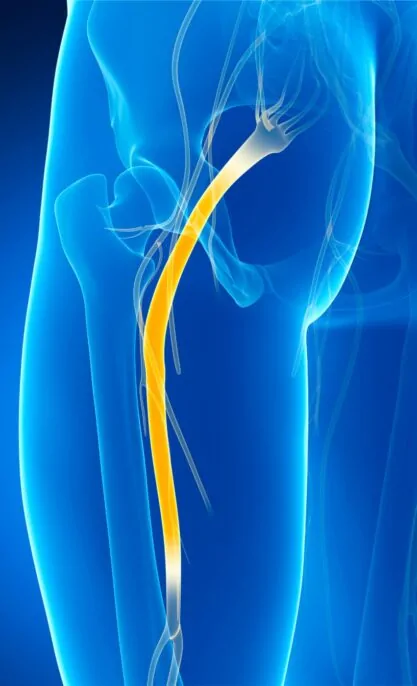
Sciatic nerve branches from the lower back region pass through the hip region and thigh. It then divides into 2 main branches in the lower part of the thigh- common peroneal nerve and tibial nerve.
The sciatic nerve supplies muscles of the back of the thigh and apparently to all the muscles of the whole of leg and foot via its two main branches named above. The sciatic nerve is responsible for sensation in the whole of the leg and foot.
If the sciatic nerve is damaged or cut, then surgical excision of the damaged part and nerve repair/grafting should be done as early as possible or within 3 months of the injury.
The results of repair are not good for sciatic nerve injuries as the injury is most of the time so up and proximal that by the time nerve fibers grow and reach up to the leg region, motor end plates or receptors have already degenerated.
The results of sciatic nerve repair are relatively good in children and in patients who come early. The result is better if direct nerve repair is possible without the use of nerve grafting and if the level of injury is not higher up and is in the lower thigh.
More than 50% of the patients require secondary procedures in the form of microvascular free-functioning transfer or arthrodesis of the foot even after nerve repair.
Then other neurological causes or compression by tumor should be investigated for. In many of such cases, release of the nerve is done and a biopsy of the nerve fascicle and muscle is taken to confirm the diagnosis of neurological disease.
Then nerve repair and grafting should be done. It might not help in restoration of the muscle function but can help in restoring the sensation to the sole of the foot.
Tendon transfers for restoring the muscle movements of the foot cannot be done in sciatic nerve injuries as all the muscles are paralyzed and no tendon is left for transfer.
Free-functioning muscle transfer can be attempted by microvascular surgical techniques to restore the function of movement of the ankle and foot in an upward direction. A strong muscle from the thigh is taken with its blood and nerve supply and fixed at 2 different points of the leg and foot. The blood and nerve supply of the muscle is joined with the blood and nerve supply in the region of the leg by microsurgical techniques. The goal is to enable the patient to extend his or her foot and toes at their joints.
The surgery is usually done under spinal anesthesia or general anesthesia and a splint or slab is given for immobilization in the post-operative period.
The patient is usually discharged tenth day after the surgery.
Sutures are removed 3 weeks after surgery.
The splint is removed 6 weeks after the surgery and gradual training of the transferred muscles is started so that they regain their newly assigned function.
Common peroneal nerve (CPN) branches from the sciatic nerve in the lower part of the thigh and passes to the leg from its outer aspect. It then divides into 2 branches-, superficial and deep, which run down the front of the leg and foot region up to the tip of the toes.
CPN provides sensation to the front and sides of the legs and to the top of the feet and toes. This nerve also controls the muscles in the leg that lift the ankle and toes upward.
The common peroneal nerve can be injured by accidents, compression, or by stretching of the nerve. It can happen in fractures and dislocation of the knee and leg.
What are the symptoms of sciatic nerve injuries?
Injuries to the peroneal nerve can cause-
Inability to point the toes upward or lift the ankle up (dorsiflexion)
Numbness on the front of leg, foot, and dorsum of toes
Tingling and pain in the front of the leg and foot region.
A distinctive style of walking is seen where the knee is raised higher than normal to clear the foot from the ground when the leg swings forward (also called steppage or foot drop gait).
If the peroneal nerve is damaged or cut, then surgical excision of the damaged part and nerve repair/grafting should be done as early as possible or within 6 months of the injury for best results.
What should be done if the patient has presented with sudden onset of paralysis of CPN with no history of injury?
If the patient has presented with sudden onset of paralysis of the peroneal nerve, then other neurological causes, leprosy or compression by tumor should be investigated.
What is the management of the patient who has presented late beyond the timing suitable for peroneal nerve repair (after 6 months to 1 year of the accident)
In such cases or in cases where the nerve is damaged beyond repair, tendon transfers should be done to strengthen the weak portions of the foot along with nerve repair and grafting (only if feasible). A strong tendon of the leg is re-routed to substitute a weaker or lost movement of the foot.
During tendon transfers for peroneal nerve palsy, one functioning tendon from the inner side of the leg is taken, re-routed, and sutured to the tendons of the front of the foot and toes so that the patient can extend his or her foot and toes at their joints. This tendon transfer also enables and restores normal walking style.
The surgery is usually done under spinal anesthesia or general anesthesia and a splint or slab is given for immobilization in the postoperative period.
The patient is usually discharged on the second day after the surgery.
Sutures are removed 14 days after surgery.
The splint is removed 4 weeks after the surgery and gradual training of the transferred muscles or tendons is started so that they regain their newly assigned function.
Are you ready for a consultation?
Your treatment will be performed by board certified plastic surgeon. Schedule your appointment now!
Are you ready for a consultation?
Your treatment will be performed by board certified plastic surgeon. Schedule your appointment now!
A True Devotion to Healing
Where Compassionate Care Meets Advanced Medicine, Guiding You on the Path to Recovery and Well-being.
24/7 Patient Support
We understand that questions and concerns don’t have office hours. That’s why we offer round-the-clock support, ensuring you have access to the care and information you need, whenever you need it.
Premium Quality Materials
We commit to only using the highest-grade materials and the latest technology in your procedures. This commitment is our promise to you for superior outcomes and your utmost satisfaction.
Safety and Hygiene Promise
Your well-being is our top priority. Across our practice, we adhere to stringent safety and hygiene protocols, reassuring you of your safety and comfort at every step of your journey with us.
The sciatic nerve branches from the lower back, extends through the hip and thigh, and provides sensory and motor functions to the leg and foot. The common peroneal nerve (CPN) originates from the thigh and controls leg muscles, while also delivering sensation to the legs and feet.
Injuries to these nerves can occur due to accidents, nerve compression, stretching, or fractures. They can also be accidentally damaged during injections or medical procedures.
Both injuries may lead to difficulties in moving the foot and toes, as well as sensations like numbness, tingling, and pain in the leg and foot regions.
Diagnosis typically involves clinical tests like the Tinel’s sign, as well as nerve conduction studies, electromyography (EMG), and in some cases, CT or MRI scans to rule out other underlying issues.
Sciatic and common peroneal nerve injuries can lead to a loss of muscle strength in the foot and toes, as well as a decreased sensation in the sole of the foot, making individuals more prone to injuries and burns.
For the best results, early surgical excision of the damaged part and nerve repair or grafting should be considered. Success rates can vary based on factors like age and timing of treatment.
In cases where nerve repair is not feasible or the injury is beyond the suitable repair timing, tendon transfers can strengthen weak areas. These procedures reroute functioning tendons to restore movement and improve patients’ quality of life.
Privacy is of utmost importance to us. Rest assured, all your personal and medical information is handled with strict confidentiality.
TRUST
Our Surgeon is highly qualified and internationally certified with a team of skilled staff to perform any surgical or non-surgical treatment on your body.
SAFETY
Safety is our priority. We maintain stringent protocols to ensure a secure environment for all patients and staff members.
Breast augmentation and breast reduction are two very different procedures. Augmentation (breast enlargement) increases breast volume and alters shape, usually for cosmetic or reconstructive goals. Reduction removes breast tissue and skin to make breasts smaller and relieve symptoms. In general, augmentation is chosen by patients who want fuller, more symmetrical breasts (or as reconstruction after…
Rhinoplasty, commonly known as a “nose job,” is a surgical procedure to reshape the nose. It can be performed for cosmetic enhancement of appearance or for functional improvement of breathing (and often both). If you’re medically informed and considering rhinoplasty, it’s important to understand the types of rhinoplasty, what the surgery involves, and how the…
When diet and exercise don’t address certain stubborn fat deposits, liposuction can be a safe and effective solution—when chosen for the right reasons and in the right patient. As a commonly performed body-contouring procedure, liposuction reshapes specific areas of the body rather than serving as a weight-loss method. At Kayakriti Plastic Surgery & Dental Center…