
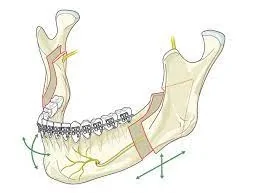
Bilateral Sagittal Split Osteotomy (BSSO) is a surgical procedure used in orthognathic surgery to reposition the lower jaw, also known as the mandible. BSSO involves cutting the mandible in a specific manner and then repositioning it to correct various deformities or abnormalities of the lower face. This procedure allows for adjustments in the mandible’s position, including moving it forward, backward, upward, or downward. BSSO is typically performed intraorally, which means there are no visible external scars on the patient’s face.
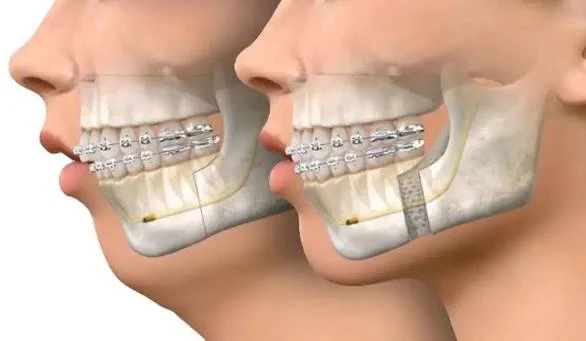
BSSO surgery is considered a safe and reliable procedure when properly diagnosed and planned by the operating surgeon. The surgical process involves:
Intraoral Access: An incision is made inside the mouth, typically behind the last teeth of the lower jaw. This approach ensures there are no external scars.
Bone Cuts: The surgeon makes specific cuts on the top and side edges of the jaw to create an overlap of bone between the cut surfaces.
Jaw Separation: Special instruments, known as osteotomes, are used to split the jaw along these cut edges.
Repositioning: The lower jaw is repositioned to its corrected location based on the preoperative planning.
Fixation: The repositioned jaw segments are fixed securely using screws and plates.
Occlusion/Bite Correction: Intraoral wiring is sometimes used to ensure proper alignment and occlusion of the lower jaw.
Closure: The incision inside the mouth is closed in layers with absorbable sutures.
In cases of severe facial deformities, BSSO can be combined with LeFort Osteotomy, leading to a procedure known as Bi Jaw or Bi Max surgery. BSSO is often routinely combined with chin surgery or genioplasty to address multiple facial concerns comprehensively.
Before performing orthognathic surgery, it is essential to confirm that skeletal growth is complete. This usually occurs around 15 to 16 years in girls and 17 to 18 years in boys. Mandibular (lower jaw) growth typically continues for a short period after maxillary (upper jaw) growth.
Successful BSSO surgery relies on thorough preoperative planning, including investigations such as 3D CT scans of the face, frontal and lateral face photos, cephalometric X-rays, and dental impressions. Cephalometric X-rays are particularly important as they reveal abnormal growth patterns of the jaws concerning the cranial base. A detailed analysis of skeletal, dental, and soft tissue findings is conducted, and dental models are created for mock surgery planning.
Several factors and conditions may contraindicate BSSO surgery, including major medical comorbidities, cardiac diseases, active dental infections, patients in the active growth phase, psychiatric disorders, uncontrolled seizure disorders, substantial differences in patient and surgeon goals, smoking or substance abuse habits, and concerns about the blood supply to the mandible.
The surgical procedure of BSSO involves several steps:
Anesthesia: The procedure is performed under general anesthesia with nasal endotracheal intubation. Local anesthesia with lidocaine and epinephrine may also be used to minimize blood loss.
Intraoral Incision: An incision is made inside the mouth, typically behind and to the side of the patient’s last lower molars. This approach avoids external scars.
Bone Cuts: The surgeon makes cuts along the top and side edges of the jaw to create overlapping bone segments for repositioning.
Jaw Separation: Osteotomes are used to split the jaw along these cut edges.
Repositioning: The lower jaw is moved to its corrected position as determined during preoperative planning.
Fixation: The repositioned jaw segments are securely fixed in place using screws and plates.
Occlusion/Bite Adjustment: Intraoral wiring may be used to achieve proper occlusion and bite alignment.
Closure: The intraoral incision is closed in layers using absorbable sutures.
Distraction surgery in BSSO involves separating the mandible without immediate advancement. Instead, an internal or external distractor is applied to both mandible segments, gradually moving the lower jaw forward over time. This technique is beneficial for patients with significantly underdeveloped mandibles.
Orthodontists play a crucial role in BSSO surgery, both before and after the procedure. Pre-surgical orthodontic treatment lasting approximately 7 to 10 months may be required. Post-surgical orthodontics aims to settle the teeth into their final occlusion, and the duration of treatment can vary depending on factors like the pre-surgical setup and planned surgical movements.
While BSSO surgery is generally safe and reliable, it may entail certain complications, including bleeding, infective complications such as abscess formation, occlusal changes, dental and periodontal injuries, unfavorable fractures, nerve injuries affecting the lower lip and teeth, TMJ dysfunction, non-union of bony segments, malocclusion issues, retraction of the gingiva, and other possible complications specific to the patient’s case. Patients should consult with their healthcare providers and surgeons for a thorough evaluation and to discuss potential risks and benefits related to BSSO surgery in their specific situation.
Are you ready for a consultation?
Your treatment will be performed by board certified plastic surgeon. Schedule your appointment now!
Are you ready for a consultation?
Your treatment will be performed by board certified plastic surgeon. Schedule your appointment now!
A True Devotion to Healing
Where Compassionate Care Meets Advanced Medicine, Guiding You on the Path to Recovery and Well-being.
24/7 Patient Support
We understand that questions and concerns don’t have office hours. That’s why we offer round-the-clock support, ensuring you have access to the care and information you need, whenever you need it.
Premium Quality Materials
We commit to only using the highest-grade materials and the latest technology in your procedures. This commitment is our promise to you for superior outcomes and your utmost satisfaction.
Safety and Hygiene Promise
Your well-being is our top priority. Across our practice, we adhere to stringent safety and hygiene protocols, reassuring you of your safety and comfort at every step of your journey with us.
Bilateral Sagittal Split Osteotomy (BSSO) is a surgical procedure used to reposition and realign the lower jaw (mandible) to correct lower face deformities. Common deformities include malocclusion, facial asymmetry, and skeletal discrepancies.
Lower face deformities can result in issues like difficulty in chewing, speaking, or breathing, as well as aesthetic concerns such as an uneven bite or facial asymmetry.
The need for BSSO is determined through a comprehensive evaluation by an oral and maxillofacial surgeon, including clinical examination, imaging studies like CT scans or X-rays, and dental models.
The goal of BSSO surgery is to reposition the lower jaw, align the teeth and facial structures, and improve both oral function and facial aesthetics. The procedure involves carefully cutting and repositioning the mandibular bones.
Kayakriti Clinic specializes in BSSO with a focus on precise surgical techniques, personalized treatment plans, and rehabilitation. Their approach includes a team of experts experienced in maxillofacial surgery.
Kayakriti Clinic offers a patient-centric approach to BSSO, providing pre-operative assessment, surgical precision, and post-operative care to optimize outcomes and facial aesthetics.
Privacy is of utmost importance to us. Rest assured, all your personal and medical information is handled with strict confidentiality.
TRUST
Our Surgeon is highly qualified and internationally certified with a team of skilled staff to perform any surgical or non-surgical treatment on your body.
SAFETY
Safety is our priority. We maintain stringent protocols to ensure a secure environment for all patients and staff members.
Breast augmentation and breast reduction are two very different procedures. Augmentation (breast enlargement) increases breast volume and alters shape, usually for cosmetic or reconstructive goals. Reduction removes breast tissue and skin to make breasts smaller and relieve symptoms. In general, augmentation is chosen by patients who want fuller, more symmetrical breasts (or as reconstruction after…
Rhinoplasty, commonly known as a “nose job,” is a surgical procedure to reshape the nose. It can be performed for cosmetic enhancement of appearance or for functional improvement of breathing (and often both). If you’re medically informed and considering rhinoplasty, it’s important to understand the types of rhinoplasty, what the surgery involves, and how the…
When diet and exercise don’t address certain stubborn fat deposits, liposuction can be a safe and effective solution—when chosen for the right reasons and in the right patient. As a commonly performed body-contouring procedure, liposuction reshapes specific areas of the body rather than serving as a weight-loss method. At Kayakriti Plastic Surgery & Dental Center…