After bariatric surgery, many patients experience significant weight loss, leading to loose and excess skin in various parts of the body that require cosmetic correction. This excess skin can also be a significant issue following diet and exercise-induced weight loss. Plastic surgeons often perform common cosmetic procedures, such as lower body lifts, upper body lifts, and medial thigh lifts, to address these concerns.
A medial thigh lift is a surgical procedure designed to remove excess skin and fat from the inner thighs. This body contouring procedure is particularly popular among both men and women after bariatric surgery or substantial weight loss. When massive weight loss occurs, the skin and soft tissues often fail to fully retract, resulting in redundancy that sags downwards and inwards. This skin and fat redundancy can affect not only the inner thighs but also the lower abdomen, mons pubis, and buttocks. It can lead to discomfort, irritation, rashes, and even infections due to the presence of massive skin folds in the inner thigh region.
As individuals age or experience weight loss, even without surgery, the skin and fat on the inner thighs can become loose and redundant, resulting in sagging. This condition can lead to hygiene issues, discomfort when wearing clothing, and aesthetic displeasure. It can diminish the satisfaction of your weight loss journey. Medial thigh lifts are also suitable for individuals who have attempted diet and exercise but have not achieved the desired reduction in excess thigh tissue. If you are committed to maintaining a healthy lifestyle and moderate weight, a thigh lift can help you regain the youthful thigh contours you desire. A medial thigh lift is often incorporated into a mommy makeover procedure.
A medial thigh lift is a common form of cosmetic surgery that addresses sagging skin on the inner thighs. This procedure involves an incision that runs from your groin down toward your knee or along the back of your thigh. A medial thigh lift can produce dramatic results, significantly impacting how your clothes fit and how you feel about your body. This surgery creates a smoother and tighter contour of the thighs, enhancing your overall profile and boosting self-confidence.
Before undergoing a medial thigh lift, there are several important steps to consider:
Complete the necessary tests as prescribed by Dr. Amit Agarwal.
Follow a strictly scheduled diet plan as advised before the surgery.
Refrain from consuming alcohol for 48 hours leading up to the surgery, as it can affect anesthesia.
Cease smoking for at least two weeks before your medial thigh lift surgery and continue to abstain for four weeks after the procedure, as smoking can hinder the healing process.
Avoid anti-inflammatory drugs and herbal supplements, as they can increase the risk of bleeding.
Share all pre-surgical workup investigations with both the operating surgeon and the anesthetist to evaluate your fitness for the procedure.
Admission to the surgical center or hospital where the surgery will be performed typically occurs on the same day or one day before the scheduled procedure.
Prior to surgery, you will meet with an anesthetist for a Pre-Anesthetic check-up.
On admission, you will sign a written consent form that outlines the details of the surgery.
Refrain from eating or drinking for a minimum of 5-6 hours before the planned procedure.
It is essential to have a caregiver who can assist you for at least three weeks after surgery.
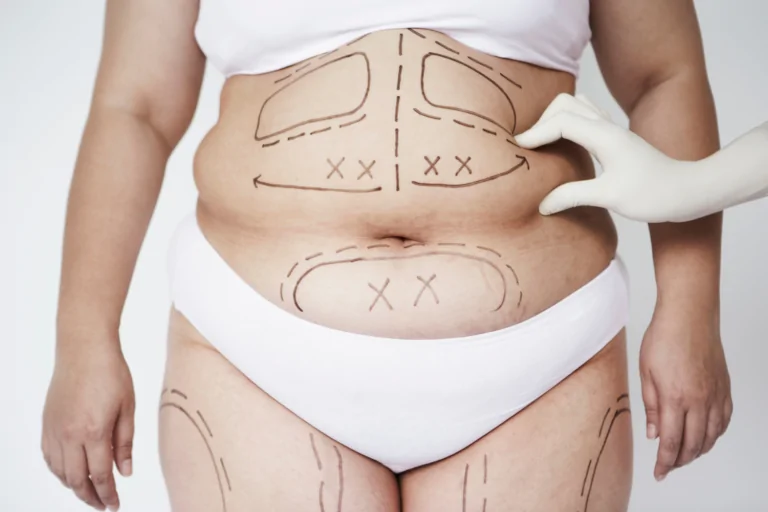
Surgical markings will be made before the procedure.
The medial thigh lift procedure entails several steps:
What Is a Medial Thigh Lift?
The extent of sagging skin is classified as a mild, moderate, or severe deformity in the medial thigh region. A mild deformity may require liposuction alone, while a moderate deformity necessitates an excisional procedure. Severe deformities often require a combination of excision and lifting, which involves significant undermining.
Dr. Amit Agarwal begins by making preliminary surgical markings on the skin to be excised. General anesthesia is administered by a highly skilled anesthetist and intensivist.
There are three types of incisions, depending on the specific areas to be treated and the extent of correction required:
Transverse Incision: This type of incision is typically used when the correction required is minimal and the excess skin primarily extends horizontally (as seen in the majority of medial thigh lift cases). The incision is made in the groin area and extends downward, wrapping around the back of the thigh.
Vertical Incision: When there is a substantial vertical excess of skin, a vertical incision is made along the inseam on the inner aspect of the thigh. This incision usually begins at the perineal crease and may extend down to just below the medial condyle of the knee.
Transverse with Vertical Component: In cases of severe deformity with excess skin in both horizontal and vertical directions, skin ellipses are removed using both transverse and vertical incisions. These incisions are strategically placed to ensure they can be concealed by various types of clothing.
Excess pinchable skin and soft tissues are carefully removed from the thigh area. Lymphatic vessels are preserved, and the incision is closed with absorbable sutures and skin adhesives. After surgery, you will notice some initial swelling and bruising, which will gradually subside.
Liposuction may be included in the procedure, depending on your specific requirements.
Recovery from a medial thigh lift procedure typically involves the following:
Dressings are applied to the surgical area.
You will be required to wear a compression garment to provide support to the thigh region. This garment helps compress the skin and reduce swelling, leading to improved body shape and contour.
In some cases, temporary drains may be placed under the skin to remove excess fluid. These drains are usually removed on the second or third day after surgery, allowing you to go home.
Patients are encouraged to walk on the second day following surgery. If excess fluid is present, a drain may be kept for removal at a follow-up visit.
To enhance recovery, refrain from strenuous activities while still moving around to prevent blood clots in your legs.
Swelling and bruising are common and should subside in 2-3 weeks.
Sutures are usually dissolvable and do not require removal.
Post-surgery discomfort can be managed with prescribed painkillers.
Soreness may persist for a few weeks.
Patients are typically encouraged to start walking the day after surgery, depending on their comfort and preference.
Full exercise routines can typically resume after 6-8 weeks.
Wearing a pressure garment continuously for the first 6 months is crucial.
Return to work can vary but is often possible after 4 weeks.
Gradually return to your normal lifestyle after 4 weeks.
You should maintain a healthy lifestyle to preserve your newly enhanced profile and confidence.
The complications and outcomes of medial thigh lift surgery can vary depending on individual factors. While medial thigh lifts generally yield favorable results, there are potential risks, including:
Rare complications related to general anesthesia.
Occasional lymphedema of the legs.
Risks associated with a higher BMI (Body Mass Index), such as wound healing issues.
Seroma formation or fluid accumulation, which typically resolves over time.
Rare cases of infection and wound dehiscence, which may require prolonged antibiotic therapy and re-suturing, respectively.
Bleeding or hematoma formation under skin flaps, which may necessitate observation or surgical drainage.
Diminished wound healing in cases of poor blood supply, which is more common in smokers, individuals with a high BMI, diabetics, those with hypothyroidism, and people with multiple medical conditions.
Occasional irregular contours, correctable with the use of a pressure garment.
Changes in skin sensation, typically recover with time.
Occasional irregular pigmentation or hypertrophic scarring of the surgical suture line, which also improves with time or may require the application of creams.
Rare occurrences of Deep Vein Thrombosis, fat embolism, pulmonary or cardiac complications, and lidocaine toxicity, especially in patients with multiple pre-existing or undiagnosed medical conditions.
These risks and potential complications should be discussed thoroughly with Dr. Amit Agarwal before the procedure.
To ensure a successful outcome and optimal recovery, it is important to adhere to the following do’s and don’ts:
Do not insist on excessive fat and skin removal, as it can compromise the blood supply to raised skin flaps.
Do not undergo surgery if you have a major chronic illness, and do not conceal it from Dr. Amit Agarwal.
Always wear the provided pressure garment, as it reduces swelling and enhances your contour.
Make lifestyle improvements to avoid further fat deposits in other body areas.
Promptly consult Dr. Amit Agarwal if you experience any complications.
Ready for Your Transformation? Contact Dr. Amit Agarwal Today for Expert Body Plastic Surgery and Reveal Your Best Self!
Are you ready for a consultation?
Your treatment will be performed by board certified plastic surgeon. Schedule your appointment now!
Are you ready for a consultation?
Your treatment will be performed by board certified plastic surgeon. Schedule your appointment now!
A True Devotion to Healing
Where Compassionate Care Meets Advanced Medicine, Guiding You on the Path to Recovery and Well-being.
24/7 Patient Support
We understand that questions and concerns don’t have office hours. That’s why we offer round-the-clock support, ensuring you have access to the care and information you need, whenever you need it.
Premium Quality Materials
We commit to only using the highest-grade materials and the latest technology in your procedures. This commitment is our promise to you for superior outcomes and your utmost satisfaction.
Safety and Hygiene Promise
Your well-being is our top priority. Across our practice, we adhere to stringent safety and hygiene protocols, reassuring you of your safety and comfort at every step of your journey with us.
During the procedure, you will not experience pain. However, some pain and swelling are common during the recovery period, which can be managed with prescribed medications.
Quitting smoking is recommended for overall health, but it is especially crucial before and after surgery to reduce the risk of complications. You should stop smoking at least 2 weeks before the surgery and continue to abstain for 4 weeks afterward.
Privacy is of utmost importance to us. Rest assured, all your personal and medical information is handled with strict confidentiality.
TRUST
Our Surgeon is highly qualified and internationally certified with a team of skilled staff to perform any surgical or non-surgical treatment on your body.
SAFETY
Safety is our priority. We maintain stringent protocols to ensure a secure environment for all patients and staff members.
Breast augmentation and breast reduction are two very different procedures. Augmentation (breast enlargement) increases breast volume and alters shape, usually for cosmetic or reconstructive goals. Reduction removes breast tissue and skin to make breasts smaller and relieve symptoms. In general, augmentation is chosen by patients who want fuller, more symmetrical breasts (or as reconstruction after…
Rhinoplasty, commonly known as a “nose job,” is a surgical procedure to reshape the nose. It can be performed for cosmetic enhancement of appearance or for functional improvement of breathing (and often both). If you’re medically informed and considering rhinoplasty, it’s important to understand the types of rhinoplasty, what the surgery involves, and how the…
When diet and exercise don’t address certain stubborn fat deposits, liposuction can be a safe and effective solution—when chosen for the right reasons and in the right patient. As a commonly performed body-contouring procedure, liposuction reshapes specific areas of the body rather than serving as a weight-loss method. At Kayakriti Plastic Surgery & Dental Center…