
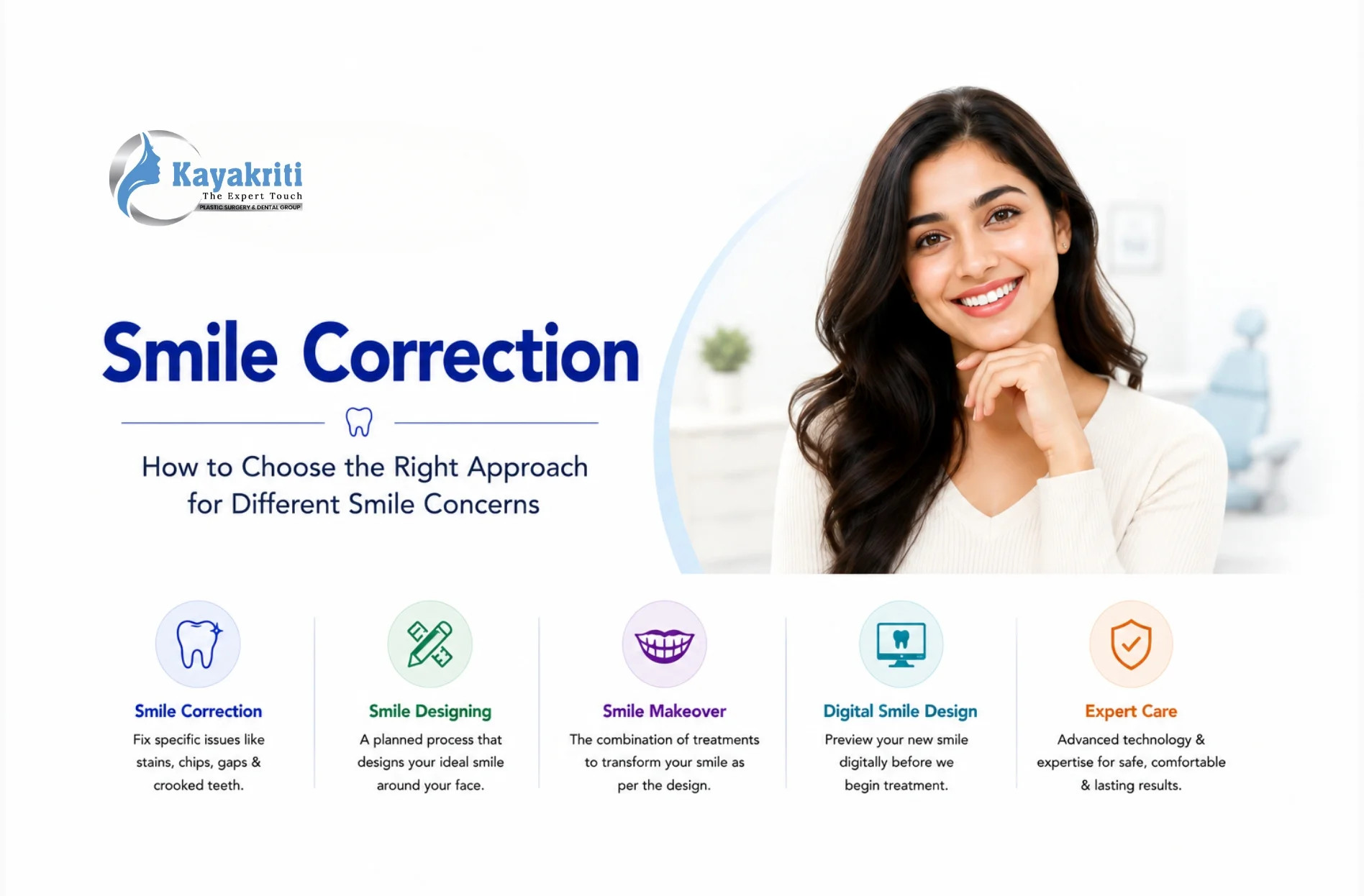

Which smile correction approach fits your concern? Compare whitening, bonding, veneers, aligners, and smile designing at Kayakriti Lucknow with Dr. Shweta Jain.
Most people can name what bothers them about their smile in a single breath — the stain that will not lift, the chipped front tooth, or the gap they have covered in photos for years. What is far harder is knowing which treatment actually addresses the concern and whether the answer is one quick procedure or a properly planned transformation. The terms do not help either: smile correction, smile designing, and smile makeover are used almost interchangeably online, yet they describe genuinely different levels of care.
This guide untangles all of it. You will learn what each term really means, which treatments suit which smile concerns, how the right approach is selected for an individual, and when combining several treatments makes sense. Prepared with the cosmetic dental team at Kayakriti Lucknow, led by Dr. Shweta Jain, MDS, it is written to help you walk into a consultation knowing exactly what to ask for — and what a well-chosen plan might look like.
What Is the Difference Between Smile Correction, Smile Designing, and a Smile Makeover?
Smile correction refers to fixing specific problems in a smile, such as a stained, chipped, or crooked tooth. Smile designing is a planned, comprehensive process that redesigns the whole smile around the face, gums, and lips. A smile makeover is the combined set of treatments carried out to achieve that design.
Think of the three terms as different levels of scope rather than competing options. Smile correction is problem-focused: one or two specific concerns are treated directly — a whitening session for stains or bonding for a chip — while the rest of the smile is left unchanged. It is targeted and conservative and may be all a person needs.
Smile designing takes a more comprehensive approach. Instead of starting with a single problem, it considers the whole picture: a comprehensive assessment of your mouth and face, including how your gums, lips, and teeth relate to one another. The dentist then designs a smile suited to your features – considering tooth shade, shape, length, and gum line together – before any treatment begins. A smile makeover is the coordinated sequence of procedures that brings this design to life, from whitening and bonding to veneers or gum contouring, to achieve the planned result.
In practice, the three overlap — every makeover contains corrections, and good corrections respect design principles. What matters when you are choosing is scale: if one concern bothers you, ask about a targeted smile correction treatment; if several do, or you want the whole smile rethought, ask about smile designing. An honest dentist will tell you which level your smile actually needs — and it may be less than you fear.
As a simple self-check, cover your smile in a photo and reveal it tooth by tooth. If your eye keeps focusing on one specific spot, you may be dealing with a correction-level concern. If the whole smile feels “not quite right” without a single culprit — because of the proportions, gum line, overall shade, or their relationship to one another — that may indicate a design-level concern because the issue lives in the relationships between elements rather than in any one tooth. Either answer is good news; both have well-established solutions.
Which Treatments Can Be Used for Different Types of Smile Concerns?
Different smile concerns call for different treatments: professional whitening for discolouration, composite bonding for chips and small gaps, veneers for multiple imperfections, clear aligners or braces for crooked teeth, gum contouring for a gummy smile, and implants or crowns for damaged or missing teeth. A dentist confirms the right match.
Here is how the most common concerns map to commonly used treatment options in modern cosmetic dentistry:
-
Discolouration and stains: Professional teeth whitening lifts surface stains and general yellowing safely and evenly. For deep, internal discolouration that whitening cannot reach, bonding or veneers restore a uniform shade.
-
Chipped or worn teeth: Composite bonding rebuilds small chips in a single sitting; veneers or crowns restore teeth with larger damage, returning both shape and strength.
-
Gaps between teeth: Bonding or veneers close small gaps quickly, while braces or clear aligners are the better answer when spacing runs through the whole smile.
-
Uneven or misshapen teeth: Gentle enamel reshaping evens out minor irregularities; veneers create consistent shape and size across several teeth at once.
-
Crooked teeth and alignment issues: Braces or near-invisible clear aligners move the teeth themselves – addressing the underlying alignment rather than simply covering it while also considering the bite.
-
Gummy smile: Gum contouring reshapes the gum line to reveal more of the natural tooth, restoring the balance between gums and teeth.
-
Damaged or missing teeth: Crowns protect heavily damaged teeth, while dental implants replace missing ones — often the finishing piece of a larger smile enhancement plan.
Notice that several concerns have more than one possible answer. Which option is right depends on the extent of the problem, the health of the tooth beneath it, and how the change fits the rest of your smile – which is exactly why the selection process in the next sections matters more than simply choosing from a menu of treatments.
The Principles Behind a Balanced Smile
Before choosing any treatment, it helps to understand what dentists are actually aiming for. A naturally attractive smile is not just white teeth — it is the sum of several elements working in harmony, and skilled smile designing evaluates each one:
-
Tooth colour: Bright and healthy-looking, free of stains — but matched to your complexion rather than being artificially white.
-
Gum display and colour: A balanced amount of healthy pink gum showing when you smile — neither a gummy smile nor teeth that look too long.
-
Spacing and proportion: Teeth that touch lightly and are proportionate to one another, creating symmetry across the smile.
-
Bite alignment: Upper and lower teeth meeting correctly, which protects dental health as well as appearance.
-
Dental midline: The line between the two front teeth, sitting centred with the face, is one of the quiet details that makes a smile look "right".
These principles explain why the same treatment can look very different on one person and another: results are more likely to look harmonious when they respect the whole face, not just the single tooth being treated. They are also the standard against which any proposed cosmetic dental treatment should be judged — will it move your smile closer to this balance, or just change one variable in isolation?
How Is the Appropriate Smile Correction Treatment Selected?
The appropriate smile correction treatment is selected through a professional assessment of the teeth, gums, bite, and facial proportions, combined with the person's goals and budget. The dentist treats any underlying dental problems first, then recommends the most conservative option — often previewed through digital smile design — that achieves the desired result.
Individual assessment is the step that separates a treatment that suits you from a treatment that merely exists. A structured selection process moves through four stages:
-
Health before beauty: Decay, gum disease or bite problems are identified and treated first, so cosmetic results are built on a sound foundation rather than layered over trouble.
-
Listening to your goals: What bothers you, what “natural” means to you, your timeline, and your budget all genuinely shape the recommendation — there is no single correct smile.
-
Facial analysis: The dentist studies your teeth against the principles above — colour, gum display, spacing, midline and bite — in the context of your lips and face.
-
Digital preview: With digital smile design (DSD) technology, using an oral scanner and design software, you can see a realistic preview of your proposed smile — and adjust its colour, shape and length — before committing to anything.
Throughout, the guiding rule is conservative-first: whitening before veneers, bonding before crowns, reshaping before covering. The right smile correction treatment is the least invasive one that can achieve your goal while preserving as much healthy natural tooth structure as possible. This assessment-led approach is precisely how Dr. Shweta Jain plans smile correction in Lucknow at Kayakriti — design first, treatment second.
Can Multiple Cosmetic Dental Treatments Be Combined for Smile Correction?
Yes, multiple cosmetic dental treatments are often combined for smile correction. A typical combined plan may sequence gum contouring first, then alignment with braces or aligners, followed by whitening, and finally bonding or veneers – so each step builds on the previous one and contributes to a balanced, natural-looking result.
Combining treatments is not about doing more — it is about doing things in the right order. Real smiles rarely have just one concern: stained teeth are often also slightly crooked; a gap may sit beside a chipped edge; a gummy smile can hide well-shaped teeth. Treating these one at a time, in isolation, tends to produce piecemeal results. A planned combination — a true smile makeover — coordinates them instead:
-
Foundations first: Gum treatment or contouring establishes the frame within which the teeth will sit.
-
Position next: If alignment is part of the plan, braces or aligners move the teeth before any cosmetic covering, so veneers or bonding are applied to well-positioned teeth.
-
Colour before shape: Whitening comes before bonding or veneers, so new restorations are matched to the final, brighter shade of the natural teeth.
-
Finishing touches last: Bonding, veneers, or a crown completes the design — and in comprehensive cases, even lip enhancement with dermal fillers can be considered to complete the frame around the smile.
Sequenced this way, each cosmetic dental treatment can complement the others, helping create a more cohesive result than a series of disconnected fixes. The full combination is planned once, at the start, as part of the smile design.
Consider a common real-world example: slightly crooked front teeth, mild yellowing, and one old chipped edge. Treated separately, a veneer placed today would be shaped around a crooked neighbour and shaded against yellowed teeth — and could create a less cohesive result if other aspects of the smile were changed later. Planned together, a short course of clear aligners straightens the teeth, whitening then brightens them, and a single small bonding repair finishes the chip — three modest treatments, sequenced correctly, working together to address concerns that no single procedure could address as comprehensively. That is the advantage of a planned combination over an isolated treatment decision.
Why Choose Kayakriti Lucknow for Smile Correction and Smile Designing
A smile plan depends heavily on the judgement and technology behind it. As a complete dental clinic in Lucknow, Kayakriti offers every treatment a smile plan might call for — whitening, bonding, veneers, crowns, orthodontics, clear aligners, gum contouring, and implants — under one roof in Rajajipuram, so your entire plan is designed and delivered by one coordinated team.
-
Verifiable Expertise in Smile Design
The practice is led by Dr. Shweta Jain – MDS, MBA (Hospital Administration), and PGDC in Cosmetic Dentistry – with more than 13 years of experience and over 3,000 patients cared for. She trained in cosmetic dentistry under Dr. Suhas Lele, official dentist for many celebrities and the Femina Miss India contest, and is a former lecturer at Saraswati Dental College, Lucknow, and Kasturba Medical College, Mangalore. For anyone comparing options for smile designing in Lucknow, credentials this specific and verifiable are a strong marker of professional expertise.
-
Design-First Technology and Honest Advice
Kayakriti's digital smile design workflow — oral scanning, design software, and preview technology — lets you see and refine your planned smile before treatment begins, while most individual procedures take just 30–90 minutes per sitting with short recovery times. Because the centre is also home to a full plastic surgery team, cases where smile enhancement extends beyond the teeth — such as surgical gummy smile correction — have access to relevant specialist expertise on site. Over 16+ years the centre has cared for 15,000+ patients across 150+ procedures, and every journey begins with a free video consultation with honest answers about what your smile does and does not need before any commitment.
-
Cosmetic Results Built on Complete Care
Cosmetic work can last longer when supported by ongoing dental care, and that is easier when both are available at the same address. As a full-service dental clinic in Lucknow, Kayakriti provides the preventive check-ups, cleaning and restorative care that protect a finished smile for years – so the team that designed your smile enhancement is the same team that is maintaining it. For patients researching smile designing in Lucknow, that continuity of care, alongside verifiable expertise and preview technology, can support a more consistent long-term result.
Conclusion: The Right Approach Starts With the Right Questions
Choosing between treatments becomes far easier once the landscape is clear: targeted smile correction for a specific concern, smile designing when the whole smile deserves a plan, and a smile makeover when several treatments work together towards one designed result. Match the treatment to the concern, respect the principles of a balanced smile, and insist on an individual assessment — and the right approach becomes much clearer.
If you are ready to find out what your smile actually needs, start where every good plan starts: with an honest, expert assessment of your individual case. With Dr. Shweta Jain's verifiable credentials, digital smile design previews, and the full range of treatments for smile correction in Lucknow under one roof, Kayakriti Clinic offers exactly that — beginning with a free video consultation. Bring the concern that bothers you and leave with a plan designed around your face, your goals, and your smile.
Disclaimer:
This blog is intended for general educational purposes only and is not a substitute for professional dental advice, diagnosis or treatment. Suitability for any cosmetic procedure varies by individual, so please consult a qualified dentist at Kayakriti Lucknow to discuss your specific concerns and options.
Frequently asked questions
What is smile correction?
How do I know which smile correction treatment I need?
Is smile correction painful?
How long does smile correction take?
How much does smile correction cost in Lucknow?
Is smile designing permanent?
Can old dental work be included in a smile correction plan?
Can smile correction fix crooked, chipped, or gapped teeth?
What happens during a smile correction consultation?
Have a question about this?
Free first consultation with our FRCS-certified surgical team. No obligation. Totally confidential.
Book a consultation