How do you know when corrective jaw surgery is needed? Learn the signs, diagnosis and candidacy for orthognathic treatment in Lucknow at Kayakriti Lucknow.
Some jaw problems announce themselves loudly — difficulty chewing, a bite that never quite meets, a jaw that visibly juts forward or sits too far back. Others build quietly for years: unexplained jaw pain, teeth wearing unevenly, a face that looks asymmetrical in photographs. Many people live with these signs without realising they may point to a skeletal jaw discrepancy — a problem with the position of the jawbones themselves that braces alone cannot always solve.
This guide explains how to recognise when orthognathic treatment in Lucknow may be worth exploring. It walks through the difference between dental and skeletal jaw problems; the signs that suggest the jaws — not just the teeth — are misaligned; how the need for corrective jaw surgery is diagnosed; and who may be a suitable candidate. Prepared with reference to the surgical team at Kayakriti Lucknow, led by Dr. Amit Agarwal, FRCS (Edinburgh), it is designed to guide you from a vague concern towards an informed, professional assessment — without alarm and without guesswork.
Skeletal vs Dental Jaw Problems: The Difference That Decides Everything
A dental problem lies in the position of the teeth within normally positioned jaws, and orthodontics alone can usually correct it. A skeletal problem lies in the size or position of the jawbones themselves, and correcting it fully may require orthognathic treatment — orthodontics combined with corrective jaw surgery.
This distinction is the single most important concept in the entire subject. Two people can have what looks like the same crooked bite, yet need completely different treatment. If the jawbones are well matched and only the teeth are tilted or crowded, braces or clear aligners can move the teeth into harmony — problem solved. But if the upper jaw (maxilla) and lower jaw (mandible) are mismatched in size or position, the teeth are simply passengers on misaligned foundations. Moving them can camouflage a mild discrepancy, but beyond a point it cannot correct the underlying skeleton — and forcing the teeth to compensate excessively can leave them unstable or compromise the result.
Orthognathic surgery — literally “straight jaw” surgery — addresses that skeletal level. By repositioning one or both jaws, orthognathic procedures align the foundations so that the bite, the airway and the facial proportions all fall into balance. That is why proper assessment always begins with one question: is this problem dental, skeletal, or a mixture of both?
What Signs May Indicate That a Person Needs Orthognathic Treatment?
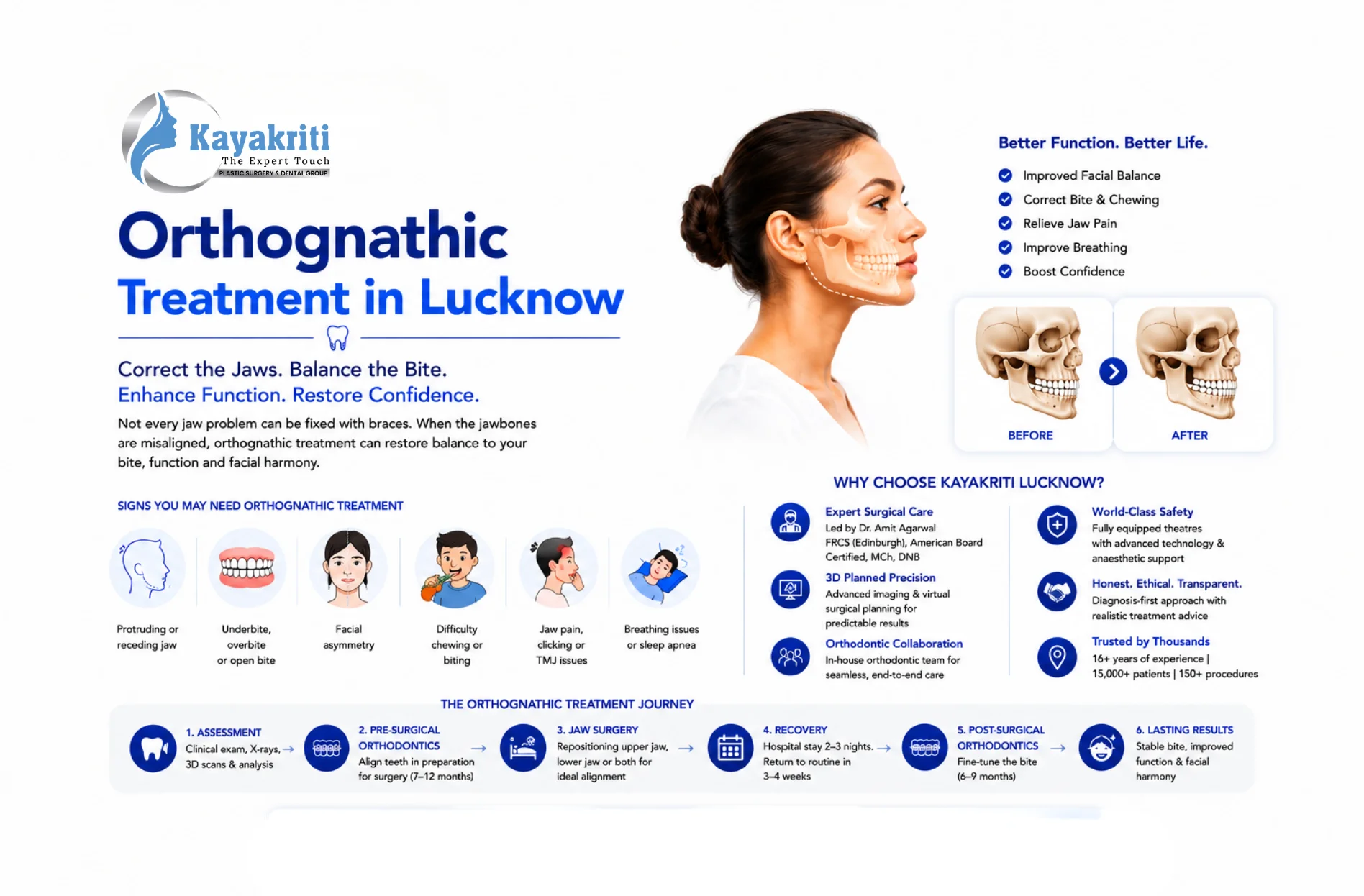
Signs that may indicate a need for orthognathic treatment include a noticeably protruding or receding jaw, an underbite, a severe overbite, an open bite where the front teeth do not meet, facial asymmetry, and functional difficulties such as trouble chewing, biting, speaking, or breathing during sleep. A professional evaluation confirms the cause.
These signs fall into two broad groups — what you can see and what you can feel. Neither group is a diagnosis on its own, but together they are the prompts that make an assessment worthwhile:
-
Visible Signs in the Bite and Face
-
Underbite: The lower jaw and teeth sit ahead of the upper teeth, often giving the chin a prominent look – commonly a sign that the lower jaw has grown further forward than the upper jaw.
-
Severe overbite or receding chin: The upper teeth sit far ahead of the lower teeth, or the lower jaw appears set back—suggesting the lower jaw may be undersized or positioned behind its ideal place.
-
Open bite: The front teeth do not touch even when the back teeth are closed, making it hard to bite into food cleanly.
-
Facial asymmetry: The chin or jawline deviates to one side, or one side of the face looks fuller or longer than the other.
-
Lips that do not close comfortably: Needing conscious effort to bring the lips together at rest can reflect underlying jaw positioning.
-
Functional Difficulties You Can Feel
-
Difficulty chewing or biting: Food is hard to tear or grind, or only a few teeth seem to do all the work.
-
Speech difficulties: Certain sounds are hard to form because the teeth and jaws do not meet where speech expects them to.
-
Excessive or uneven tooth wear: Teeth wearing down prematurely because the bite loads them unevenly.
-
Chronic jaw or TMJ discomfort: Persistent pain, clicking or fatigue in the jaw joints and muscles.
-
Breathing concerns during sleep: Habitual mouth breathing or sleep-disordered breathing, which can be linked to jaw position narrowing the airway.
If several of these feel familiar, that is not a verdict — it is a signal. The right response is not worry, but a structured evaluation of whether the cause is dental, skeletal or both. That is precisely what an assessment for jaw correction surgery is designed to answer.
When Is Corrective Jaw Surgery Considered Instead of Orthodontic Treatment Alone?
Corrective jaw surgery is considered when the bite problem is skeletal — caused by the size or position of the jawbones — and too large for orthodontics alone to correct. Braces can move teeth within the jaws, but they cannot reposition the jaws themselves, so significant discrepancies need combined orthodontic and surgical treatment.
Orthodontics is remarkably capable, and for the majority of bite problems it is the complete answer. The limits of orthodontic treatment become more apparent in situations such as these:
-
The discrepancy is too large: Mild skeletal differences can often be camouflaged by tilting teeth. Beyond that envelope, camouflage produces strained, unstable tooth positions rather than a genuine correction.
-
Growth has finished: In growing children, functional appliances can guide jaw development. Once skeletal growth is complete, that window closes, and a true skeletal discrepancy can no longer be redirected by appliances alone.
-
Function, not just alignment, is affected: When chewing, speech or the airway is compromised by jaw position, straightening teeth without addressing the jaws leaves the functional problem in place.
-
The face matters to the outcome: Orthodontics moves teeth within the smile; it cannot correct a long face, a receded chin or marked asymmetry. Where facial balance is part of the goal, only jaw-level correction changes it.
In practice, the modern standard is not “surgery instead of orthodontics” but the two working together: a phase of pre-surgical orthodontics — often seven to twelve months — positions the teeth correctly within each jaw; surgery then repositions the jaws, followed by a shorter post-surgical phase that fine-tunes the bite. This combined pathway is what orthognathic treatment involves, and it is how orthognathic procedures in Lucknow are planned at Kayakriti — with the surgeon and orthodontist sharing one continuous plan rather than two parallel ones.
How Is the Need for Orthognathic Surgery Diagnosed?
The need for orthognathic surgery is diagnosed through clinical examination of the bite, jaws and face, combined with imaging — X-rays, cephalometric analysis and CT-based 3D models — plus dental impressions and facial photographs. These records let the surgical team measure the skeletal discrepancy precisely and plan whether and how surgery would correct it.
Diagnosis is a process of measurement, not impression. A thorough evaluation typically brings together:
-
Clinical examination: The surgeon assesses how the teeth meet, how the jaws move, the health of the jaw joints, and the proportions of the face at rest and in animation.
-
Cephalometric analysis: A standardised skull X-ray on which precise angles and distances between the jaws, teeth and skull base are measured — the classic tool for quantifying exactly where and how large a skeletal discrepancy is.
-
CT-based 3D models: Three-dimensional imaging that lets the team see the jaws from every angle and rehearse each planned bone movement virtually before the operation — improving predictability and shortening theatre time.
-
Dental impressions and photographs: Models of the teeth and standardised facial photography complete the record, so the dental, skeletal and facial pictures can be planned together.
The result of all this is a clear, evidence-based answer: whether the problem is skeletal, how significant it is, and whether orthodontics alone, camouflage, or combined surgical treatment is likely to offer the most stable outcome. At Kayakriti Lucknow, this planning discipline — rehearsing every move of bone virtually before theatre — is central to how jaw surgery in Lucknow is delivered, and it is also why a proper diagnostic work-up is worth insisting on wherever you seek care.
Who May Be a Suitable Candidate for Corrective Jaw Surgery?
Suitable candidates for corrective jaw surgery are generally people whose skeletal growth is complete — usually around 16 in girls and 18 in boys — who have a significant jaw discrepancy affecting bite, function, breathing or facial balance; are in good general health; and are prepared for the combined orthodontic-surgical journey.
Candidacy rests on a few practical pillars rather than a single test:
-
Completed growth: Operating before the jaws finish growing risks the discrepancy partially returning, so timing matters — typically from around 16 years in girls and 18 in boys, confirmed on imaging.
-
A genuinely skeletal problem: The records must show that the jaws, not just the teeth, are the cause — otherwise orthodontics alone is the better path, and an ethical team will say so.
-
Meaningful impact: Surgery is considered when the discrepancy affects chewing, speech, tooth wear, the airway or facial balance in a way that matters to the patient — not for trivial differences.
-
Good general health: Fitness for general anaesthesia and normal healing, as reviewed through the medical history during assessment.
-
Realistic expectations and commitment: The full pathway — orthodontics, surgery, recovery and refinement — spans many months, and the best outcomes are generally seen in patients who understand and commit to the process.
For those who are candidates, it helps to know briefly what jaw correction surgery involves. Depending on the diagnosis, the upper jaw may be repositioned (a LeFort osteotomy), the lower jaw (a bilateral sagittal split osteotomy, or BSSO), or both together (bi-jaw surgery); chin reshaping (genioplasty) may sometimes be added for facial balance. Surgery is performed under general anaesthesia in fully equipped theatres. A hospital stay is typically two to three nights, and most patients return to office work within three to four weeks while following a soft diet for about six weeks as the bones consolidate. Crucially, no ethical surgeon recommends a more extensive operation than the diagnosis supports – the goal is a stable bite, an open airway and a face that looks natural, like yours.
Why Choose Kayakriti Lucknow for Orthognathic Treatment
Corrective jaw treatment sits at the intersection of surgery, orthodontics, and facial aesthetics – making the expertise of the team behind it a key consideration. Kayakriti Lucknow, a plastic, reconstructive and dental centre in Rajajipuram, offers the full spectrum of orthognathic procedures in Lucknow — LeFort osteotomy, BSSO, bi-jaw surgery and genioplasty — alongside in-house orthodontics, so the entire journey runs under one coordinated plan.
-
Surgical Expertise You Can Verify
The surgical practice is led by Dr. Amit Agarwal — FRCS (Edinburgh), American Board Certified, MCh and DNB in Plastic Surgery — with international fellowship training and more than 16 years of experience. As Project Director for Smile Train, his craniofacial workload spans cleft and jaw conditions across all ages, and his team coordinates directly with orthodontists throughout treatment, sharing imaging, surgical plans and post-operative timelines. Credentials of this kind — specific, senior, and verifiable — provide an important basis for assessing a surgical recommendation.
-
Planning, Safety and Honest Advice
Every case is planned using facial photography, dental impressions, cephalometric analysis, and CT-based 3D models, with each bone movement rehearsed virtually before surgery. Surgery takes place in fully equipped theatres with experienced anaesthetic support, and detailed risk discussion is part of every consultation. Over 16+ years, the centre has cared for more than 15,000 patients across 150+ procedures — and every enquiry begins with a free video consultation, where honest answers come before any commitment. Second opinions are welcomed, because sound orthognathic treatment starts with a diagnosis you can trust.
-
Coordinated Care, Wherever You Are Coming From
Because the full pathway spans many months, practical coordination matters as much as surgical skill. Patients seeking jaw surgery in Lucknow at Kayakriti receive a single continuous plan: the surgical team shares imaging and treatment timelines directly with the treating orthodontist; follow-up reviews are scheduled around each stage of healing; and patients travelling from across Uttar Pradesh and beyond receive coordinated scheduling for surgery and reviews. Privacy is protected throughout — photographs, scans and personal records remain confidential, and consultations are held in private rooms. For anyone comparing options for jaw surgery in Lucknow, this combination of planning discipline, orthodontic coordination and discretion is worth weighing alongside credentials.
Conclusion: From Signs to Certainty, One Assessment at a Time
A protruding or receding jaw, a bite that never meets, uneven wear, chronic jaw strain, or disturbed breathing at night — none of these signs is a diagnosis, but each is a reason to look deeper. The real question is whether the problem lies in the teeth or in the jawbones beneath them, and that question can be answered through a precise, measurable assessment. Understanding the underlying cause is the first step towards deciding whether orthognathic treatment in Lucknow is the right path for you.
If the signs in this guide feel familiar, let measurement replace worry. With Dr. Amit Agarwal's verifiable surgical credentials, 3D-planned orthognathic procedures, and honest, diagnosis-first advice, Kayakriti Lucknow offers a structured assessment to help determine the appropriate treatment path — beginning with a free video consultation. Whether the answer turns out to be orthodontics alone or combined orthognathic surgery, you can move forward with a clearer understanding of your condition and treatment options.
Disclaimer:
This blog is intended for general educational purposes only and is not a substitute for professional medical advice, diagnosis or treatment. Suitability for orthognathic treatment varies by individual, so please consult a qualified surgeon at Kayakriti Lucknow for an assessment of your specific condition.
Frequently asked questions
What is orthognathic treatment?
Can jaw problems be fixed without surgery?
When is corrective jaw surgery considered instead of orthodontic treatment alone?
At what age can someone have orthognathic surgery?
Who may be a suitable candidate for corrective jaw surgery?
Is orthognathic surgery painful?
Will corrective jaw surgery change how my face looks?
Yes. Repositioning the jaws can change facial proportions because the underlying jaw structure contributes to the shape and balance of the face. The aim of jaw correction surgery is not to make the face look completely different but to improve facial balance while correcting the underlying skeletal problem. 3D planning can help patients understand the expected changes before surgery.
How long does the full orthognathic treatment take?
How is the need for orthognathic surgery diagnosed?
Have a question about this?
Free first consultation with our FRCS-certified surgical team. No obligation. Totally confidential.
Book a consultation