
Flat 30–50% OFF for Reconstructive Surgery patients with AYUSHMAN CARD
Plastic Surgery and Dental Clinic Book Appointment

Pseudoaneurysms

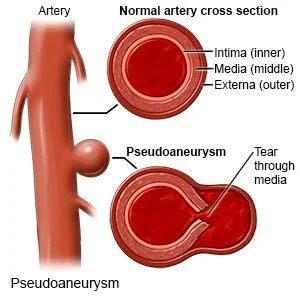
A pseudoaneurysm, also known as a false aneurysm, is a condition where the wall of a blood vessel becomes injured, causing blood to leak into the surrounding tissues under the skin. It is distinct from a true aneurysm, which is characterized by a bulging or weakening of the vessel wall, without any injury or leakage.
Pseudoaneurysms — hero image

About Kayakriti and Your Surgeon

A short walk-through of our Lucknow clinic, plus a brief introduction from Dr. Amit Agarwal.

A quick tour of Kayakriti clinic, Lucknow

A quick tour of Kayakriti clinic, Lucknow

Meet Dr. Amit Agarwal

Meet Dr. Amit Agarwal

Know more about Kayakriti →

Pseudoaneurysm

A pseudoaneurysm, also known as a false aneurysm, is a condition where the wall of a blood vessel becomes injured, causing blood to leak into the surrounding tissues under the skin. It is distinct from a true aneurysm, which is characterized by a bulging or weakening of the vessel wall, without any injury or leakage.

Causes of Pseudoaneurysms

Pseudoaneurysms can result from various causes, including:

Repeated Needle Punctures: This is a common cause, particularly in patients undergoing dialysis for kidney failure. Repeated needle punctures in the groin region, such as the femoral artery, can lead to vessel wall injury.

Infection: Infections at the site of catheterization or puncture during dialysis can contribute to the development of pseudoaneurysms.

Orthopedic Surgery: Pseudoaneurysms can also occur as a result of orthopedic surgical procedures.

Differentiating True Aneurysm from Pseudoaneurysm

In a true aneurysm, the vessel wall weakens and bulges without any injury. Blood collects within the bulging area, but there is no leakage from the vessel itself.

In a pseudoaneurysm, blood pools near the damaged site of the vessel due to an injury, creating a false aneurysm that communicates with the artery.

Common Locations of Pseudoaneurysms

Pseudoaneurysms are frequently found in the following areas:

Groin Region (Femoral Artery): Repeated needle punctures during dialysis in the groin region, especially the femoral artery, can lead to the development of pseudoaneurysms.

Elbow Region (Brachial Artery): Patients undergoing dialysis may develop brachial artery pseudoaneurysms near the arteriovenous (AV) fistula in the arm.

Why Pseudoaneurysms Are Common in Dialysis Patients?

  • Brachial Artery Pseudoaneurysm: These can occur due to injuries during catheterization for dialysis, such as repeated needle punctures.
  • Femoral Artery Pseudoaneurysm: Inadequate compression after multiple needle punctures to the femoral artery during dialysis can lead to the formation of pseudoaneurysms. Additionally, patients on dialysis may receive blood-thinning medications, which can increase the risk of bleeding from catheterization sites. Kidney failure patients may also have an inherent defect in blood clot formation, which can contribute to the problem.

Symptoms of Pseudoaneurysm

  • Pseudoaneurysms manifest as painful lumps with skin bruising.
  • They may feel like they are throbbing.
  • A whooshing sound called a ‘bruit’ can often be heard over the lump due to the pulsation of blood under the skin.

Complications of Pseudoaneurysms

  • Pseudoaneurysms are a cause for concern because they can rapidly expand due to their communication with the artery, potentially leading to rupture, significant bleeding, and even death.
  • Therefore, prompt treatment is essential after a diagnosis is made.

Diagnosis of Pseudoaneurysms

Color Doppler ultrasound is the primary diagnostic tool for detecting and assessing pseudoaneurysms. It can distinguish pseudoaneurysms from hematomas and confirm the presence of thrombotic masses, aiding in the decision-making for potential surgical correction.

Treatment of Pseudoaneurysms

The choice of treatment depends on the size and severity of the pseudoaneurysm:

Pseudoaneurysms Less Than 2 cm: Smaller pseudoaneurysms may resolve on their own after the leakage is sealed and bleeding stops, with periodic ultrasound monitoring.

Pseudoaneurysms Wider Than 2 cm: Larger pseudoaneurysms typically require medical intervention to seal the leakage and repair the damaged blood vessel. Treatment options may include:

  • Stenting: Placement of a stent in the damaged artery to stop blood from leaking, usually performed by an interventional radiologist.
  • Compression: Ultrasound-guided compression, where external pressure is applied under ultrasound guidance to stop bleeding from the vessel.
  • Medication Injection: Ultrasound-guided injection of thrombin, a clot-building medication, to stop further bleeding.
  • Surgery: In cases of large and rapidly expanding pseudoaneurysms, surgery is the most effective and common treatment option.

When Surgery Is Recommended?

Surgery is recommended in the following circumstances:

  • There is a risk of perforation and ulceration.
  • The pseudoaneurysm is rapidly enlarging.
  • Episodes of bleeding occur.
  • The overlying skin shows signs of inflammation or is unhealthy.

Surgical Procedure:

Surgery for pseudoaneurysms is performed under regional anesthesia. During surgery, the entire pseudoaneurysm is excised, the internal clot is removed, and the damaged blood vessel is repaired, often under microscopic magnification. In some cases, the vessel may need reconstruction using a vein graft.

See the difference

Before & After — Pseudoaneurysms

Drag the handle to compare. All photos are real patients shared with consent.

Images shown are intended to provide general treatment insight only. Every patient is unique, and outcomes may vary depending on individual condition and treatment plan.

Common questions

Frequently asked questions

What is a Pseudoaneurysm, and how does it differ from a true aneurysm in terms of its development, characteristics, and causes?
A Pseudoaneurysm, also known as a false aneurysm, occurs when the wall of a blood vessel is injured, causing blood to leak into surrounding tissues under the skin. It is distinct from a true aneurysm, which results from the bulging or weakening of the vessel wall without injury.
What are the common causes and risk factors for Pseudoaneurysms, and how do these factors contribute to the development of this condition?
Common causes include trauma, medical procedures, and vascular diseases. Risk factors may include underlying conditions that weaken blood vessel walls, such as atherosclerosis.
What are the key signs and symptoms of a Pseudoaneurysm, and how do they differ from those of a true aneurysm?
Symptoms may include a pulsating mass, pain, or localized swelling. Pseudoaneurysms typically result from a specific injury or medical procedure, while true aneurysms may develop more gradually without a known cause.
How is a Pseudoaneurysm diagnosed, and what diagnostic methods are used to assess its size, location, and potential complications?
Diagnosis involves physical examination, imaging studies, and possibly ultrasound or angiography to determine the size, location, and extent of the Pseudoaneurysm.
What treatment options are available for individuals with a Pseudoaneurysm, and how is the choice of treatment method determined based on the Pseudoaneurysm's characteristics and location?
Treatment options may include observation, minimally invasive procedures, or surgical repair. The choice of treatment method is determined by factors like size, location, and potential complications.
What are the potential complications or risks associated with untreated or poorly managed Pseudoaneurysms, and how can timely intervention mitigate these risks?
Complications may include rupture or infection. Timely intervention is essential to prevent these complications and address the Pseudoaneurysm effectively.
Real stories

What our patients say about Kayakriti

★★★★★
"Kayakriti Plastic Surgery & Dental Clinic is one of the best clinics — excellent doctors and a very professional team. The clinic is clean, well-maintained, and uses advanced technology. Doctors explain everything clearly and make you feel comfortable throughout the treatment. Highly recommended for both plastic surgery and dental care."
B R
★★★★★
"My big brother had a critical accident in August 2025 — his right foot was injured badly. Thanks to Dr Amit, the plastic surgery was a great success and now he is walking on his feet. Dr Amit is polite, humble, and guided us like family."
Arif Mekrani
★★★★★
"Dr Amit Agarwal is really a very good plastic surgeon — he operated on my leg. The treatment is really very good and the staff behaviour is very nice."
Ashish Kumar
★★★★★
"Dr Amit Agarwal performed surgery for diabetic foot on my father. We were very troubled before going to him; after his treatment the condition is much better. He debrided all the infection and did grafting on the same."
Anwar Khan
★★★★★
"Dr Amit Agarwal operated on my patient for a congenital defect. A renowned plastic surgeon of Uttar Pradesh with excellent post-operative results. He explains every step of the treatment very nicely and is very determined towards his work."
Ranjeet Kumar
★★★★★
"Dr Amit is very approachable, so it is easy to talk to him and ask all our queries. Before operating he explains the entire process with all the pros and cons. His staff is well-trained and well-behaved — I had a wonderful experience."
Shashimukesh Verma
★★★★★
"Dr Amit Agarwal operated on my sister who got burnt two years back, leaving burn scars in her neck area. With the help of tissue expanders he has cured her scars to the utmost. Thank you sir for the treatment."
Shantanu Bajpai
★★★★★
"Dr Amit Agarwal operated on my child for a congenital defect and has delivered brilliant results. We are completely satisfied with his treatment and recommend him to everyone."
Ajay Verma
★★★★★
"I consulted Dr Amit Agarwal for my son's gynaecomastia operation. His results have been very good — now my son is much more confident and comfortable with his looks after the operation."
Suneel Kumar
★★★★★
"Dr Amit operated on my patient for a lip augmentation surgery to give her lips a proper cosmetic shape. The post-operative results are very good — she is very satisfied."
Mohd Umair
★★★★★
"Dr Amit Agarwal operated on my son for gynaecomastia. Due to the puffiness in his chest he felt very embarrassed in public. Thanks to Dr Amit's treatment my son feels much better aesthetically and has gained a lot of confidence about his looks."
Shoaib Alam
★★★★★
"We consulted Dr Amit for cosmetic correction of my daughter's facial profile. He brought her upper jaw forward, surgically improving her appearance. It was a tough operation but the results are phenomenal — we are really satisfied with the look now."
Urmila Choudhary
★★★★★
"My son had his fingers joined since birth, causing a lot of functional problems. Dr Amit Agarwal performed syndactyly release on him. Now he is much better and there were no issues regarding post-operative complications."
Sunil Verma
★★★★★
"I got my rhinoplasty done under Dr Amit. The shape of my nose wasn't nice and my facial profile was getting hampered. Dr Amit elevated my nose to give it proper shape — now it is looking fine and I am very satisfied."
Sarwat Fatima
★★★★★
"Dr Amit Agarwal operated on my patient for deformed lips. He gave my patient a very aesthetic appearance and we are highly satisfied by the surgery. The cosmetic correction was successful with no complications."
Jayanti
★★★★★
"Dr Amit Sir is really a very good plastic surgeon — great nature, very cooperative staff, excellent scope for cosmetic treatment. Very happy and satisfied with the treatment. It really changed my life and enhanced my confidence."
Ravi Kashyap
★★★★★
"Dr Amit Agarwal performed cosmetic surgery on my nephew, who was facing a lot of issues with confidence due to gynaecomastia. After Dr Amit's treatment he is much better and has a boosted confidence level."
Upendra Kumar
★★★★★
"I met a road accident two months back and my ring finger fractured. My orthopaedic doctor recommended Dr Amit for the joint fracture management. After he operated, my condition is much better."
Rahul Singh
★★★★★
"Dr Amit Agarwal operated on my patient for vascular malformation. He removed the complete swelling through an operation which went well and the results are good. The staff kept us well informed at every step and the whole process went smoothly."
Prem Kumar
★★★★★
"My patient wasn't satisfied with the aesthetic appearance of her lips. Dr Amit performed a lip augmentation surgery — it made her lips look more full and richer. She is very satisfied with the results."
Chandan Kumar Verma
★★★★★
"We were very troubled after my son met a road accident in which his jaw got fractured. Dr Amit confirmed the diagnosis quickly and proceeded for the surgery — through plating he joined the bones of the jaw and stabilised it. The condition now is much better."
Amit Pandey
★★★★★
"My brother is diabetic and hurt his leg; the wound was not healing for a long time. Dr Amit debrided all the infected part and covered it with a flap. The wound is now healed — we are lucky we got the correct treatment on time."
Daram Singh

All reviews verified on our Google profile.

Have a question about Pseudoaneurysms?

One free video consultation. Honest answers. No pressure.

or call us at +91 96 95 94 0009 +91 96 95 94 0006

Chat with us