Open vs closed rhinoplasty surgery in Lucknow explained — differences, technique selection, advantages & recovery, by Dr. Amit Agarwal at Kayakriti, Lucknow.
The nose sits at the centre of the face, so even small changes to its shape can transform overall facial harmony. That is why rhinoplasty — one of the most popular facial procedures in the world — calls for both surgical precision and artistic judgement. If you are researching rhinoplasty surgery in Lucknow, one of the first things worth understanding is that the procedure can be performed using two main techniques: open and closed rhinoplasty. Each has a distinct surgical approach, unique advantages, and its own recovery pattern.
This guide explains the difference between the two techniques, how surgeons decide which to use, the benefits of each, and how recovery compares. Whether you are exploring rhinoplasty for cosmetic reasons or to improve breathing, understanding these basics will help you have a more informed conversation with your surgeon and approach your nose surgery with confidence.
What Is Rhinoplasty Surgery?
Rhinoplasty surgery, commonly called a nose job, is a procedure that reshapes the nose to improve its proportion, symmetry, and function. It can refine the bridge, tip, or nostrils, correct deformities after injury, and improve breathing by addressing internal structures such as a deviated septum. As a highly precise form of nasal plastic surgery, it balances aesthetic goals with the need to preserve healthy airflow and function.
Not every nasal concern requires an operation. For minor irregularities, non-surgical rhinoplasty — which uses dermal fillers to smooth small bumps or add definition — can be an option with no downtime. However, for structural changes, tip reshaping, or functional correction, surgical rhinoplasty remains the gold standard. The right choice between surgical and non-surgical rhinoplasty is always made during a personalised consultation.
What Can Rhinoplasty Address?
Rhinoplasty is a versatile procedure that patients choose for both aesthetic enhancement and functional improvement. Common goals include:
- Cosmetic enhancement: smoothing a nasal hump, straightening the bridge, refining the tip, or adjusting nostril size.
- Post-trauma restoration: correcting deformities that follow an injury and restoring the nose's natural form.
- Functional improvement: opening breathing passages and correcting a deviated septum for better airflow.
- Aesthetic refinement: achieving a balanced profile that harmonises with the rest of the face.
Who Is a Good Candidate for Rhinoplasty?
Good candidates for rhinoplasty are people whose facial growth is complete — generally around age 15 for girls and a little later for boys — who are in good overall health, do not smoke, and hold realistic expectations about the outcome. As with any face cosmetic surgery, a positive, well-informed mindset matters as much as physical readiness. During the consultation, the surgeon confirms suitability and explains how nose reshaping fits within the wider range of face plastic surgery in India, so the plan reflects your individual anatomy and goals rather than a generic template. This careful matching of the patient to the procedure is a core principle of safe face plastic surgery in India and a key reason why results appear natural and balanced.
What Is the Difference Between Open and Closed Rhinoplasty?
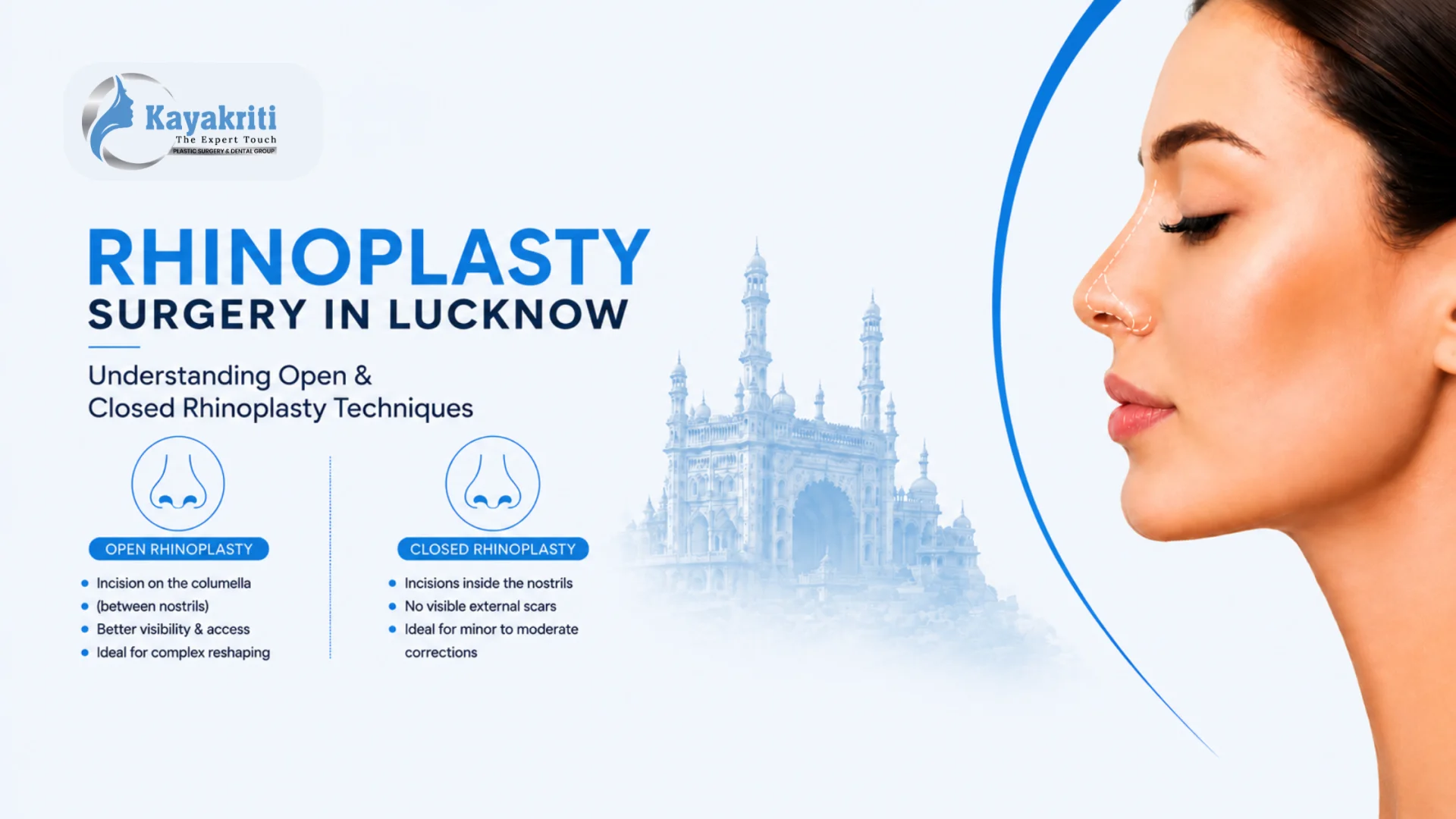
The main difference between open and closed rhinoplasty is the incision. In open rhinoplasty, a small incision is made across the columella (the skin between the nostrils), allowing the surgeon to lift the skin and fully view the nasal framework. In closed rhinoplasty, all incisions are made inside the nostrils, leaving no visible external scar. Both reshape the same structures; they differ in access and visibility.
-
Open Rhinoplasty
In open rhinoplasty, the surgeon makes a tiny incision across the columella and lifts the skin to expose the underlying bone and cartilage directly. This full visibility allows highly precise reshaping, accurate placement of cartilage grafts, and detailed work on the nasal tip. It is often preferred for complex cases, major structural changes, and revision surgery. The small external scar typically fades and becomes very difficult to see once healed.
-
Closed Rhinoplasty
In closed rhinoplasty, also called endonasal rhinoplasty, every incision is hidden inside the nostrils. Because the skin is not fully lifted off the framework, there is no external scar and usually less swelling. This approach suits patients who need more modest or moderate refinements, and it is valued for a tidier early recovery. It is, however, technically more demanding because the surgeon works with a more limited view of the nasal structures.
The table below summarises how the two rhinoplasty surgery techniques compare:
|
Feature |
Open Rhinoplasty |
Closed Rhinoplasty |
|
Incision |
Small external incision on the columella plus internal incisions |
Incisions entirely inside the nostrils |
|
External scar |
Tiny scar that usually fades and is hard to see |
No visible external scar |
|
Surgeon's view |
Full, direct view of nasal framework |
More limited view |
|
Best suited to |
Complex cases, major reshaping, grafting, revisions |
Modest to moderate refinements |
|
Early swelling |
Slightly more, especially at the tip |
Often less |
How Is the Appropriate Technique Selected?
The appropriate rhinoplasty technique is selected based on the complexity of the changes needed, whether the nose requires major structural work or grafting, if it is a first-time or revision procedure, the patient's nasal anatomy and skin type, any functional breathing issues, and the surgeon's expertise. The decision is always made jointly during a detailed consultation.
Choosing between open and closed rhinoplasty is a key part of surgical planning. An experienced surgeon weighs several factors:
- Extent of reshaping: Major changes to the bridge or tip, or significant grafting, often favour the full visibility of open rhinoplasty.
- Primary vs revision surgery: Revision (second) procedures usually benefit from the direct access of the open technique because the anatomy is more complex.
- Functional needs: Correcting a deviated septum or breathing problem may influence the approach and is planned alongside the cosmetic goals.
- Nasal anatomy and skin thickness: These affect how the nose will heal and which technique gives the most predictable result.
- Patient goals and scar preference: Patients wanting absolutely no external scar may lean towards closed rhinoplasty where it is suitable.
This is where the surgeon's experience matters most. During a rhinoplasty surgery consultation at Kayakriti in Lucknow, the face and nose are carefully analysed, photographs are taken, and the technique is matched to your anatomy and goals — not chosen by default. Selecting the right approach is a hallmark of an experienced and the best rhinoplasty surgeon in India because the technique should serve the desired result, not the other way around.
What Are the Advantages of Each Approach?
Open rhinoplasty offers precision, full visibility, and control for complex reshaping and grafting, making it ideal for major or revision cases. Closed rhinoplasty offers no external scar, less swelling, a shorter operating time, and a quicker early recovery, making it ideal for modest refinements. Neither technique is universally better—each excels in different clinical situations.
Advantages of Open Rhinoplasty
- Direct, full view of the nasal framework for maximum precision.
- Ideal for complex reshaping, structural grafting, and tip refinement.
- The preferred choice for revision nose surgery, where anatomy is altered.
- Greater control over symmetry in difficult cases.
Advantages of Closed Rhinoplasty
- No visible external scar, as all incisions are inside the nostrils.
- Usually less swelling and a tidier early recovery.
- Often a shorter operating time.
- Well suited to modest and moderate cosmetic refinements.
Both techniques are part of a complete face cosmetic surgery toolkit, and an expert surgeon is skilled in both. The goal of any face plastic surgery in India is a natural, balanced result — so the best approach is simply the one that achieves your goals most safely and predictably.
How Do Recovery Timelines Differ Between Techniques?
Recovery timelines for open and closed rhinoplasty are broadly similar: a nasal splint is usually worn for about a week, initial swelling and bruising settle within one to two weeks, and most people return to work within two weeks. Closed rhinoplasty often involves slightly less early swelling, while the nasal tip following open rhinoplasty may take a little longer to fully refine.
At Kayakriti, rhinoplasty is generally performed under general anaesthesia and takes about two to three hours, with initial recovery of one to two weeks and the refined final result becoming visible over roughly three to six months. The general timeline below applies to both techniques:
|
Stage |
What to Expect |
|
First week |
Splint in place; swelling and bruising peak then begin to settle |
|
Splint removal (~1 week) |
Splint removed; early shape becomes visible |
|
1–2 weeks |
Most bruising fades, and many people return to work and light daily activities. |
|
3–6 weeks |
Strenuous activity and contact sports gradually resumed as advised |
|
3–6 months |
Refined result emerges as residual swelling resolves |
|
Up to 12 months |
Subtle tip refinement continues, especially after open rhinoplasty |
Individual healing varies, so these are general guides rather than fixed rules. Following your surgeon's aftercare advice — keeping the head elevated, avoiding strenuous activity, and attending follow-ups — is the most reliable way to support a smooth recovery after nose surgery in Lucknow, regardless of technique.
Surgical Planning and Safety at Kayakriti
A successful outcome depends on the surgeon as much as the technique. Rhinoplasty surgery in Lucknow at Kayakriti Clinic is performed by Dr. Amit Agarwal, who is certified by the American Board of Plastic Surgery and holds the FRCS from Edinburgh and an M.Ch. in plastic surgery. With fellowship training in aesthetic and facial plastic surgery and more than 16 years of experience, he is recognised among the leading choices for the best rhinoplasty surgeon in India, skilled in both open and closed techniques.
Surgical planning at Kayakriti is detailed and personalised. The consultation includes a full facial analysis, assessment of your nasal anatomy and skin, clinical photographs, a discussion of realistic outcomes, and a review of your general health. Procedures are carried out using FDA-grade implants and internationally certified instruments, with strict operating-theatre protocols, single-use disposables, and infection-control standards. A free video consultation is available for patients travelling from outside Lucknow, making expert nose surgery in Lucknow accessible to those across Uttar Pradesh, Delhi, and Bihar.
Rhinoplasty is one part of Kayakriti's broader cosmetic surgery services in Lucknow, which span facial, breast, and body procedures. This depth of experience across cosmetic surgery services in Lucknow allows the team to tailor each rhinoplasty procedure precisely to the individual's anatomy and goals.
Conclusion: Making an Informed Choice About Rhinoplasty
Open and closed rhinoplasty are two routes to the same goal: a balanced, natural-looking nose that suits your face. Open rhinoplasty offers precision for complex work, while closed rhinoplasty offers a scar-free, tidy recovery for more modest changes. The right technique depends on your anatomy, your goals, and your surgeon's expert judgement — which is why choosing an experienced surgeon for your rhinoplasty surgery in Lucknow matters more than the technique alone.
If you are considering rhinoplasty or nasal plastic surgery, book your free consultation with Dr. Amit Agarwal at Kayakriti, Lucknow — call +91 96959 40009 — to discuss which approach is right for you and take the first step toward a confident new profile.
Disclaimer: This article is for general information only and is not medical advice. Individual suitability, results, and recovery vary — please consult a qualified, registered surgeon before making any decision.
Frequently asked questions
What is rhinoplasty surgery?
Can rhinoplasty improve breathing as well as appearance?
Yes. Rhinoplasty can improve both the appearance and function of the nose. In addition to reshaping the nose for better facial balance and symmetry, the procedure can correct structural issues such as a deviated septum, collapsed nasal valves, or other internal abnormalities that restrict airflow. By addressing these concerns, rhinoplasty can help patients breathe more comfortably while also achieving their desired aesthetic outcome. During your consultation, the surgeon will assess both cosmetic and functional concerns to develop a personalised treatment plan.
What is the difference between surgical and non-surgical rhinoplasty?
What is the difference between open and closed rhinoplasty?
The main difference between open and closed rhinoplasty lies in the location of the incisions. In open rhinoplasty, a small incision is made across the columella (the strip of skin between the nostrils), allowing the surgeon full visibility of the nasal framework for precise reshaping. In closed rhinoplasty, all incisions are made inside the nostrils, leaving no visible external scar. Open rhinoplasty is often preferred for complex or revision cases, while closed rhinoplasty is typically suitable for modest to moderate refinements. The most appropriate technique depends on your anatomy, goals, and the complexity of the changes required.
Is open or closed rhinoplasty better?
Neither is universally better. Open rhinoplasty offers more precision for complex or revision cases, while closed rhinoplasty avoids an external scar and often has less early swelling for modest changes. The best technique depends on your anatomy and goals, which your surgeon determines during consultation.
Does rhinoplasty leave a visible scar?
How long is recovery after rhinoplasty surgery?
Initial recovery after rhinoplasty surgery is usually one to two weeks, when the splint is removed and most bruising fades. The refined final result emerges over about three to six months, with subtle changes continuing up to a year.
When can a patient return to work after rhinoplasty?
Most patients return to desk work and light daily activities within one to two weeks, depending on the extent of the procedure and individual healing. Your surgeon will provide personalised recovery guidance.
How much does rhinoplasty cost in Lucknow?
The cost of nose surgery in Lucknow depends on the technique, the complexity of the case, and whether functional correction is needed. Kayakriti provides a clear, itemised estimate during the consultation, so you know the full cost before deciding.
What happens during a rhinoplasty consultation?
A rhinoplasty consultation includes a discussion of your goals, assessment of your nasal anatomy, facial analysis, medical history review, treatment planning, and an explanation of expected results, recovery, risks, and costs.
Who is the best rhinoplasty surgeon in Lucknow at Kayakriti Clinic?
Have a question about this?
Free first consultation with our FRCS-certified surgical team. No obligation. Totally confidential.
Book a consultation