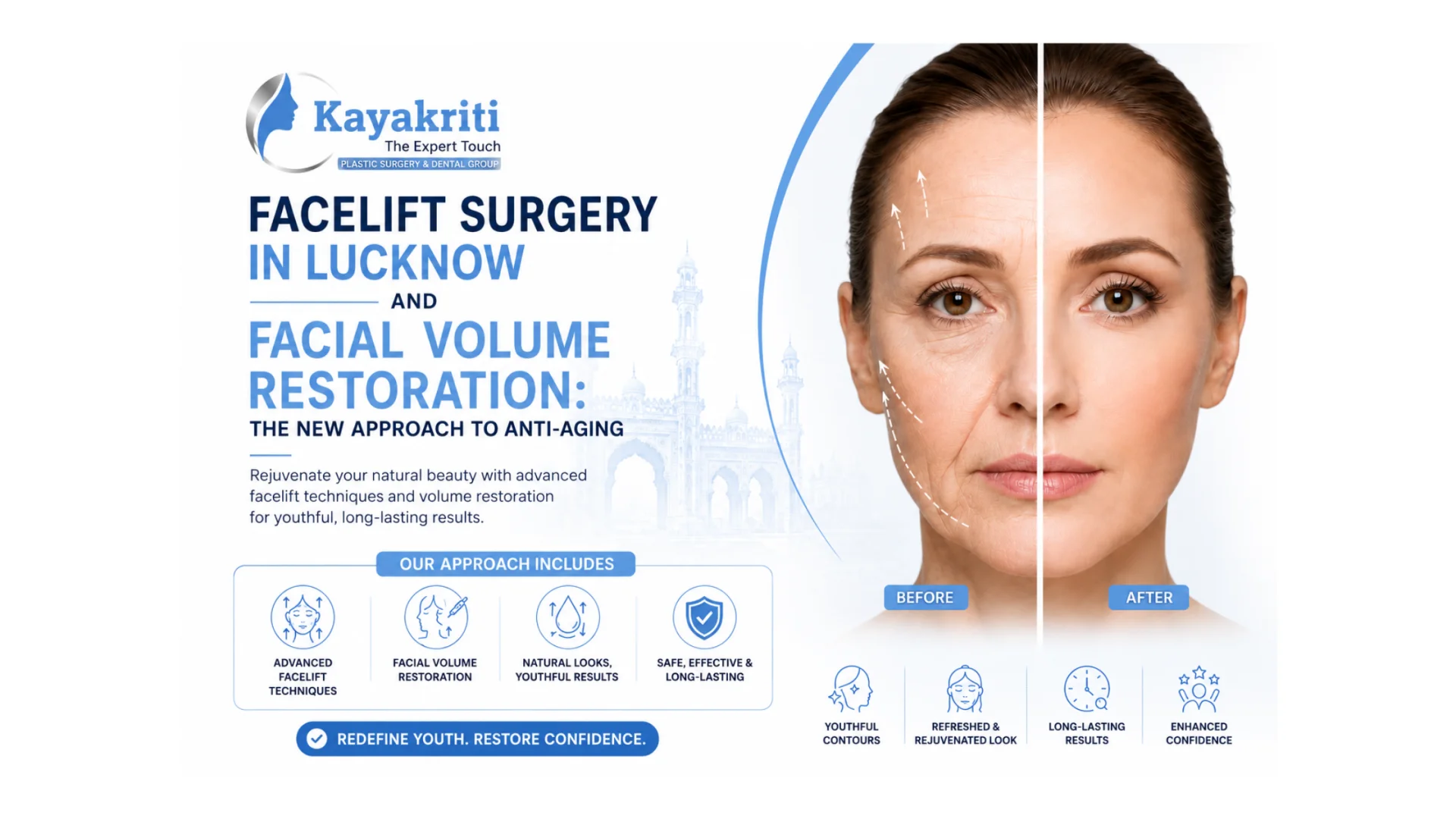
Facelift surgery in Lucknow with facial volume restoration — the modern anti-ageing approach. Learn the types, recovery, and expert care at Kayakriti, Lucknow.
For decades, anti-ageing surgery focused on one idea: lift and tighten sagging skin. But our understanding of how the face ages has advanced. Modern surgeons now know that aging is not only about descent — it is also about deflation, as the face gradually loses volume. The most natural, lasting results come from addressing both. This is why facelift surgery in Lucknow is increasingly combined with facial volume restoration, creating a refreshed yet authentic appearance rather than a tight, over-pulled look.
This guide explains why volume loss matters in ageing, how surgeons combine lifting with facial rejuvenation, which treatments work best together, and what recovery involves. Whether you are exploring facelift surgery for the first time or comparing options, understanding this modern, balanced approach will help you make a confident, informed decision.
Understanding Facial Aging: More Than Just Sagging Skin
As we age, the face changes in three connected ways: the skin loses elasticity and begins to sag, the deeper support structures weaken, and the youthful fat pads that give the face its fullness gradually shrink and shift downward. The result is sagging in some areas and hollowing in others — flatter cheeks, deeper folds, and a less defined jawline.
A traditional facelift surgery effectively addresses the first two changes superbly: it repositions deeper tissues and removes excess skin to restore a firmer contour. But lifting alone cannot replace lost volume. That is where modern facial rejuvenation adds the missing piece — restoring fullness so the lifted face also looks soft, rounded, and youthful rather than simply tight.
This shift in thinking — from simply pulling skin tighter to lifting and replacing volume — is the single biggest change in modern anti-ageing surgery. It reflects a simple truth: a face does not only sag; it also empties. Treating just one half of that equation tends to leave the result looking incomplete, which is exactly why the combined approach has become the standard for natural-looking facial rejuvenation.
Why Is Facial Volume Loss an Important Aspect of Ageing?
Facial volume loss is an important aspect of aging because the face's youthful shape depends on full, well-positioned fat pads and strong bone support. As these deflate and the underlying bone resorbs over time, the cheeks flatten, the under-eye area hollows, folds deepen, and the face looks tired or gaunt. Restoring this lost volume is essential to a natural, youthful result.
A young face is characterised by gentle fullness in the cheeks and a smooth transition between facial areas. With age, several things happen:
- Fat pad deflation: The compartments of facial fat shrink, so areas that were once plump become flat or hollow.
- Fat descent: Remaining fat slips downward, creating jowls and deepening the folds around the nose and mouth.
- Bone resorption: The facial skeleton subtly loses volume, reducing the support that holds soft tissue in place.
- Skin thinning: Collagen declines, so skin becomes thinner and less able to bounce back.
Because volume loss is such a central part of aging, simply tightening the skin can sometimes make a face look drawn. The solution is to combine tissue lifting with volume restoration — often using facial fat grafting — so the face is both lifted and refilled. This balanced philosophy is the foundation of modern anti-ageing care.
What Is Facelift Surgery and What Types Are Available?
Facelift surgery, medically called rhytidectomy, is a procedure that repositions deeper facial tissues and removes excess skin to reduce sagging in the mid-face, jowls, and neck. Several types exist — from a full traditional facelift to a less invasive mini facelift — and the right one depends on the degree of ageing and the patient's goals.
Understanding the main types helps you have a more informed consultation:
|
Type of Facelift |
What It Involves and Suits |
|
Traditional (SMAS) Facelift |
Repositions the deeper muscle layer (SMAS) and removes excess skin; suits moderate to advanced sagging of the mid-face, jowls, and neck |
|
Mini Facelift |
Uses shorter incisions to lift the lower face and jowls with less downtime; suits early or mild sagging |
|
Deep Plane Facelift |
Releases and repositions deeper tissue layers for a natural, long-lasting lift; suits more significant sagging |
|
Mid-Facelift |
Targets the cheeks and under-eye area where volume descends; often paired with volume restoration |
|
Neck Lift |
Tightens neck muscles and skin; it is frequently combined with a facelift for a balanced result |
Choosing the most appropriate technique requires expert clinical judgement. A consultation at a reputable facelift clinic assesses your skin, volume, and bone structure to recommend the approach — and the complementary treatments — that will give the most natural outcome. Selecting facelift surgery in Lucknow at a specialist face lift clinic ensures the plan is tailored, not generic.
How Is Volume Restoration Incorporated Into Facial Rejuvenation?
Volume restoration is incorporated into facial rejuvenation mainly through facial fat grafting, where the patient's own fat is harvested, purified, and injected into areas that have hollowed with age. It can be performed during or alongside a facelift, refilling the cheeks, temples, and folds so the lifted face also regains its youthful fullness. Dermal fillers offer a non-surgical alternative for smaller corrections.
The most natural way to restore volume is facial fat grafting, which uses your own tissue rather than a synthetic product. Fat is gently harvested from an area such as the abdomen or thighs, processed, and reinjected into the face. Because it uses your own living tissue, it integrates naturally and may also improve skin quality, thanks to the regenerative cells it contains.
Fat grafting comes in refined forms, each with a purpose:
- Micro fat grafting: Restores volume to deflated areas such as the cheeks and temples.
- SNIF (sharp needle intradermal fat): Softens fine wrinkles and lines.
- Nano fat grafting: Injected to improve skin texture, radiance, and elasticity rather than add bulk.
When combined with a lift, this approach transforms results. The facelift repositions sagging tissue, while volume restoration refills what has deflated — together delivering complete facial rejuvenation. For minor volume changes without surgery, dermal fillers and a tailored face makeover plan can also be discussed. Patients seeking facial rejuvenation in Lucknow increasingly choose this combined surgical-and-volume strategy for its natural, lasting effect.
How Does Facial Volume Affect Youthful Facial Contours?
Facial volume directly shapes youthful contours by creating the soft, rounded fullness that defines a young face. Well-positioned volume in the cheeks lifts the mid-face, supports the under-eye area, and forms the smooth, heart-shaped outline often called the 'triangle of youth'. As volume is lost, this triangle inverts, and the face takes on an older, heavier-jawed appearance.
In a youthful face, the widest point is across the cheeks, tapering down to a defined chin — a triangle pointing downward. Full cheeks cast soft highlights and support the tissues above and below them. With age and volume loss, the cheeks flatten and fat descends to the jawline, so the face's widest point shifts downward and the triangle effectively inverts.
Restoring volume to the cheeks and mid-face re-establishes that youthful triangle, smooths the folds around the mouth, and refreshes the under-eye area. This is why combining a facelift with facial fat grafting often produces such natural-looking results: it does not just remove sagging, it rebuilds the underlying architecture of a young face. The contour, not just the skin, is rejuvenated.
What Treatments May Complement Facelift Surgery?
Treatments that complement facelift surgery include facial fat grafting and dermal fillers for volume, a brow lift and eyelid surgery for the upper face, a neck lift for the lower face, and non-surgical options such as Botox, laser resurfacing, and skin treatments for texture and fine lines. Combining these creates a balanced, comprehensive rejuvenation.
A facelift addresses sagging beautifully, but the whole face ages together. These complementary treatments are commonly combined for a harmonious result:
- Facial fat grafting and fillers: Restore lost volume to the cheeks, temples, and folds.
- Brow lift and eyelid surgery (blepharoplasty): Refresh the upper face and eyes, which a facelift does not address.
- Neck lift: Tightens the neck and jawline for balance with the lifted face.
- Botox and laser treatments: Soften dynamic wrinkles and improve skin texture; useful for facial wrinkle treatment between or after surgical procedures.
- Skin resurfacing and care: Improve tone, pigmentation, and radiance for effective facial wrinkle removal and a smoother complexion.
By planning these together, a surgeon can design a complete face makeover rather than treating one feature in isolation. The goal of both surgical and non-surgical facial wrinkle treatments is always a natural, balanced face — and thoughtful facial wrinkle removal is part of that bigger picture.
Who Is a Good Candidate for Facelift Surgery and Volume Restoration?
Good candidates for facelift surgery and volume restoration are adults in good general health, with realistic expectations, who show visible sagging together with age-related volume loss in the face or neck. Non-smokers or those willing to stop smoking before and after surgery generally experience better healing outcomes. A consultation confirms suitability and the ideal combination of treatments for each person.
- Visible sagging of the cheeks, jowls, or neck, along with flattening or hollowing from volume loss.
- Good overall health, with any chronic conditions well controlled.
- Non-smoker status, or a willingness to stop smoking around the time of surgery, for better healing.
- A positive, realistic outlook about what surgery can and cannot achieve.
Age matters far less than skin quality, health, and goals. Many patients between their forties and sixties benefit most, but a personalised assessment — not a number — determines whether facelift surgery and volume restoration are right for you. This is also the stage at which the surgeon decides whether a full or mini lift and how much volume restoration will best suit your face.
How The Combined Procedure Is Planned
Planning a combined lift-and-volume procedure is detailed work. The surgeon maps which areas need lifting and which need refilling, decides whether facial fat grafting is performed during the same operation, and sequences any complementary treatments. Clinical photographs — and sometimes older photos from the patient's youth — help guide a result that looks like a refreshed version of you rather than a different face. This personalised planning is what distinguishes natural facial rejuvenation from a generic, one-size-fits-all outcome.
Facelift Recovery: What to Expect
Facelift recovery generally takes about two weeks for visible bruising and swelling to settle, with most people returning to work and social activities within two weeks. Mild swelling can persist for several weeks, and the final, fully refined result emerges over a few months. Volume restoration with fat grafting follows a similar, slightly shorter timeline, with most swelling resolving within one to two weeks.
Individual healing varies, but the general timeline below applies to most patients:
|
Stage |
What to Expect |
|
First few days |
Swelling, bruising, and dressings; rest with the head elevated |
|
Around 1 week |
Dressings and sutures reviewed; bruising begins to fade |
|
About 2 weeks |
Most visible bruising settles; many return to work and social life |
|
3–4 weeks |
Swelling largely resolves; gradual return to exercise as advised |
|
Several months |
The refined, natural final result emerges as tissues settle |
Following your surgeon's aftercare advice — keeping the head elevated, avoiding strenuous activity, and attending follow-ups — supports the smoothest recovery and the best long-term result from your facelift surgery.
Expertise and Safety at Kayakriti
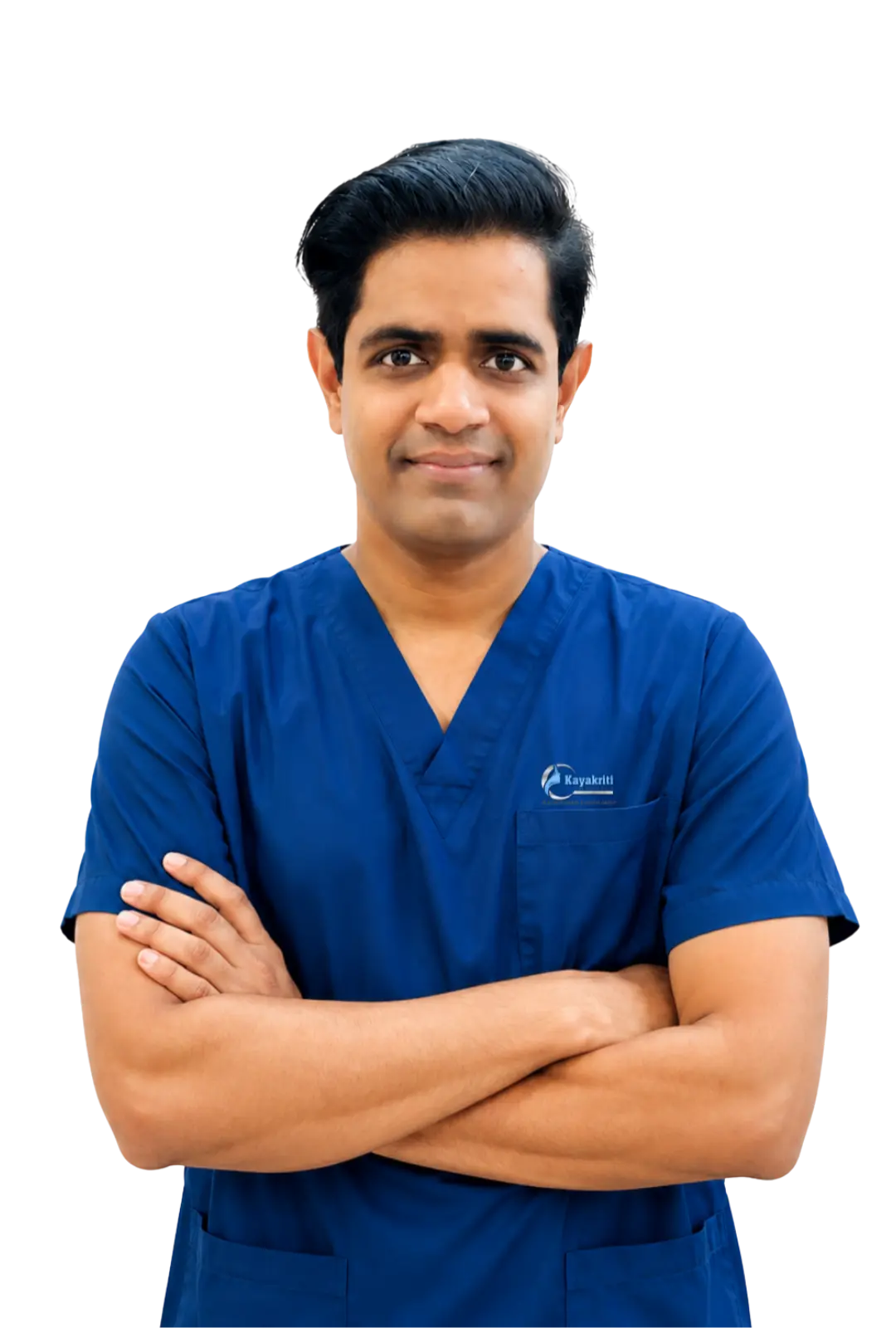
A natural anti-ageing result depends on a surgeon who understands both lifting and volume. Facelift surgery in Lucknow and facial volume restoration at Kayakriti are performed by Dr. Amit Agarwal, who is certified by the American Board of Plastic Surgery and holds the FRCS from Edinburgh and an M.Ch. in plastic surgery. With fellowship training in aesthetic and facial plastic surgery and more than 16 years of experience, he is regarded among the leading choices for a top plastic surgeon in Lucknow, skilled in combining surgical lifting with fat grafting for balanced, natural outcomes.
Every plan begins with a detailed consultation that assesses your skin quality, volume loss, wrinkles, and jawline, reviews your medical history, and discusses realistic outcomes and combination options. Procedures use FDA-grade materials and internationally certified instruments, with strict operating-theatre protocols, single-use disposables, and infection-control standards. A free video consultation is available for patients travelling from outside the city, making expert care accessible to those across Uttar Pradesh, Delhi, and Bihar. This careful, personalised approach reflects the standard of care patients expect from a trusted face lift clinic and a top plastic surgeon in Lucknow.
Conclusion: A Balanced, Natural Approach to Anti-Aging
Ageing is both sagging and deflation, so the most natural results come from treating both together. By pairing a lift with volume restoration, modern facelift surgery in Lucknow rejuvenates not just the surface of the face but also its underlying contours — for a refreshed, authentic look rather than a tight one. Combined with complementary treatments and expert planning, this balanced philosophy defines today's approach to facial rejuvenation.
If you are considering facelift surgery or facial rejuvenation in Lucknow, book your free consultation with Dr. Amit Agarwal at Kayakriti, Lucknow — call +91 96959 40009 — to discuss a personalised, natural anti-ageing plan.
Disclaimer: This article is for general information only and is not medical advice. Individual suitability, results, and recovery vary — please consult a qualified, registered surgeon before making any decision.
Frequently asked questions
What is facelift surgery?
Why does facial volume loss occur with ageing?
What is the difference between a facelift and facial volume restoration?
How does facial fat grafting help with facial rejuvenation?
Is fat grafting better than fillers for facial volume?
What treatments may be combined with facelift surgery?
Who is a good candidate for facelift surgery and volume restoration?
Can facial wrinkles be treated without a facelift?
How long does facelift recovery take?
What happens during a facelift consultation?
Is facelift surgery safe?
Who is the best surgeon for facelift surgery in Lucknow?
Have a question about this?
Free first consultation with our FRCS-certified surgical team. No obligation. Totally confidential.
Book a consultation